
Wondering whether any “earn money online UK” guide gives you a true picture, or just another list padded with hype?
Here’s the short answer. Yes, there are legitimate ways to make money online in the UK. They often work best as extra income. Expectations are often the first thing that trips people up.
The useful question is not whether online earning exists. It’s which options are realistic for your time, how you’ll get paid, and what friction shows up once you start. Some platforms pay to PayPal. Some pay by direct bank transfer. Some let you cash out in GBP, while others pay in points or dollars first. Those details affect whether an app is worth using.
The same goes for admin. Many beginners skip over identity checks, age limits, and payout rules until they hit a withdrawal problem. In the UK, it also helps to know where tax starts to matter. If you earn money from side work, HMRC’s trading allowance is one of the first rules to understand before income builds up.
This guide focuses on seven practical methods that are easy to try without formal qualifications. That includes paid task platforms such as Klink Finance, research studies, website testing, surveys, rewards portals, game-based apps, and general GPT sites.
For each one, the goal is simple:
explain how it works
show what setup you need
cover common payment methods used by UK users
flag verification checks and payout delays
point out where people waste time
Start small. Track your hourly return. Keep the methods that pay reliably, fit your schedule, and cash out without hassle.
1. Complete Paid Tasks and Offers with Klink Finance
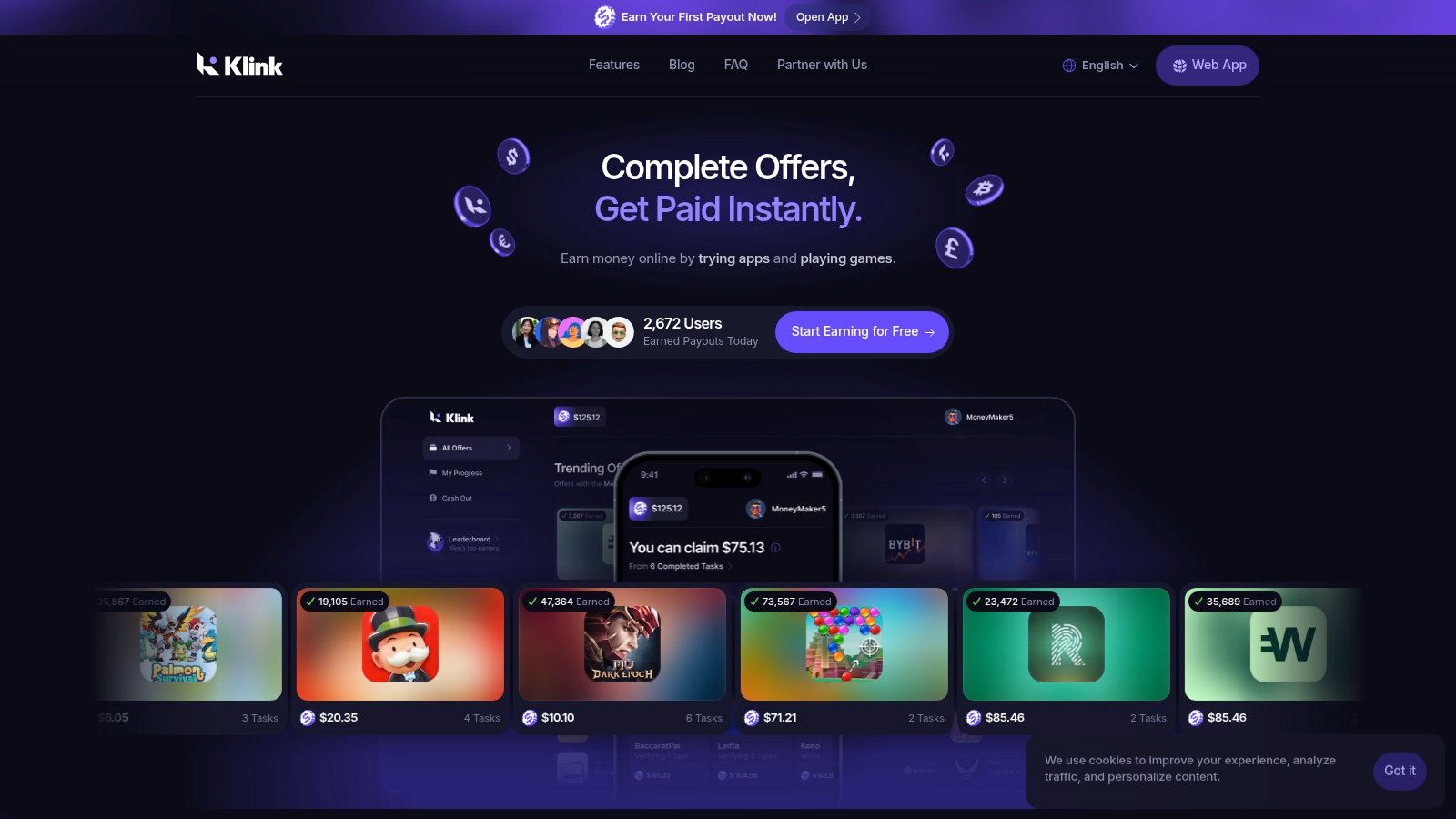
Want a low-friction way to test online earning without applying for jobs or building a portfolio?
Klink Finance is a rewards platform built around simple tracked actions. You earn by completing tasks such as trying apps, playing mobile games, answering surveys, or finishing partner offers with specific steps.
For UK beginners, the appeal is simple. You can start quickly, test a few task types, and see whether the time-to-reward trade-off works for you. It sits firmly in the extra-income category, not a replacement for a part-time wage.
Why Klink Finance is worth testing
A lot of task platforms blur together. What separates them in practice is offer mix, tracking clarity, and how easy it is to cash out.
Klink Finance is useful if you want several earning formats in one place instead of signing up for a separate app for surveys, another for games, and another for offers. You can try a few categories and work out which ones suit your patience level and device. This variety is a significant advantage for people who get bored easily.
The tracking view also matters. If you can see whether an offer is pending, completed, or payable, it is easier to spot problems early and decide whether a platform is worth sticking with.
Practical rule: Test the platform with a small offer first. A successful first payout tells you more than any promo page.
How to start without wasting hours
The fastest way to lose money on GPT-style platforms is poor offer selection. The fastest way to get useful results is to treat the first week like a trial run.
Use this approach:
Start with one category: Pick surveys, app installs, or games first. That makes it easier to judge your real hourly return.
Read every condition: Some offers only track if you install through the platform link, accept cookies or app tracking, and complete steps in order.
Use a spare email address: It keeps sign-up emails, promo codes, and follow-up marketing out of your main inbox.
Take screenshots: Save proof of install, registration, and milestones in case support asks for evidence.
Check payout options early: If the platform supports PayPal or bank-friendly cashout in GBP, that is usually more practical for UK users than points with awkward conversion rules.
A quick test beats a long guess.
What usually pays, and what usually drags
Short app offers and simple sign-up tasks often give the clearest return. Surveys can work too, but only when the screening process is not too aggressive.
Game offers are mixed. Early milestones may pay reasonably well, but later levels often slow down and turn into a time sink unless you were going to play anyway. I would only keep doing those if the reward per hour still looks decent after the first day or two.
Skip anything that has vague terms, very long completion windows, or a reward that depends on spending money unless you have checked the maths carefully. On platforms like this, a task is only good if it tracks properly and pays out at a rate you can live with.
UK digital advertising keeps feeding this model because brands are willing to pay for measurable actions such as installs and registrations. That is the business behind the offers. Users get a share of that spend for completing them. For background on that trend, Andava’s UK digital marketing statistics give useful context.
UK details to check before you commit
Beginners often get caught out. The offer looks simple, but the admin shows up later.
Check these points first:
Payment method: Look for PayPal, bank transfer, or another option you already use. GBP support makes life easier.
Verification: Expect email confirmation at minimum. Some platforms may also ask for phone checks or ID before withdrawal.
Device limits: Certain offers only work on Android or iPhone, and some are restricted to new users only.
Offer tracking rules: Ad blockers, VPNs, and switching devices mid-offer can stop credit from registering.
Tax records: If side income adds up, HMRC may expect you to declare it once you go over the trading allowance. Keep a simple spreadsheet with date, platform, task type, and amount received.
That last point is easy to ignore when earnings are small. It is still worth setting up from day one. A basic record takes five minutes and saves hassle later.
2. Participate in Academic Research with Prolific
Want survey-style work that feels less random and more worthwhile? Prolific is one of the few platforms that does that well.
It focuses on research studies from universities, academic teams, and companies. The difference shows up fast. Tasks usually come with clearer instructions, a defined purpose, and fewer of the long screening loops that waste time on standard survey sites.
That does not mean constant work. Study flow depends on your profile, timing, device, and whether a researcher needs people like you right now. Some days you will see several good opportunities. Other days, almost nothing.
Why Prolific stands out
Prolific suits people who answer carefully and follow instructions. Speed matters less than reliability.
In practice, that means:
Better task quality: Studies are often more focused than market research surveys.
Less pointless screening: You usually see key details before starting.
Stricter quality checks: Attention checks and consistency checks are common.
Lower volume: Good platform, but not a full-time income source.
That trade-off is worth understanding early. A smaller number of decent studies can beat a larger number of low-paying questionnaires that keep disqualifying you.
How to set up your account properly
Your profile drives your earning potential here. If it is incomplete or inaccurate, you will qualify for less.
Start with these steps:
Fill in your profile accurately: Researchers screen by age, work status, education, health factors, and other traits. Wrong answers can lead to rejected work or account issues.
Turn on study alerts: Good studies can fill in minutes.
Check desktop and mobile access: Some studies only work on one device type.
Read consent forms properly: You are joining research, not just clicking through an offer wall.
Use matching payment details: If Prolific asks for verification, your name should match your withdrawal details.
For UK users, also check the practical bits before you spend time on it:
Payment options: Confirm whether your withdrawals go to PayPal or another method you already use.
Currency handling: GBP support is easier. If payouts are converted, watch for fees.
Verification: Email checks are standard. Some users may face extra identity or account checks before cashing out.
What to expect once you start
Prolific works best as one part of a mix. Keep it open, accept studies that fit, and skip anything that looks too fiddly for the pay.
I would treat it as a quality-first option, not a volume play. That is the advantage. You spend less time fighting through junk tasks, but you also give up the steady stream of low-value work that other platforms push.
A few habits help:
Respond quickly: Popular studies disappear fast.
Answer consistently: Researchers notice low-effort responses.
Do not rush: One bad submission can hurt future access more than it helps your hourly rate.
Track your earnings: If your side income grows, HMRC may expect a declaration once you go over the trading allowance. A simple spreadsheet with dates, study titles, and amounts received is generally sufficient.
One final warning. Do not try to outsmart academic platforms. If you want repeat access, being accurate, patient, and dependable is part of the job.
3. Test Websites and Apps with UserTesting
Want a side hustle that pays for your opinion without trapping you in endless surveys? UserTesting is one of the cleaner options. You record your screen, speak your thoughts out loud, and work through tasks on a website or app so a company can see where real users hesitate, get confused, or give up.
The trade-off is simple. Pay per task is often better than basic survey sites, but test volume is less predictable and you usually need to qualify first. If you can explain what you are thinking in plain English, that trade-off can be worth it.
Who this suits best
UserTesting works well for people who can stay focused for 10 to 20 minutes and keep talking while they click. You do not need design skills or technical knowledge. You need clear speech, patience, and the ability to describe friction as it happens.
Good testers tend to do a few things consistently:
Say what you expected to happen: This helps the client spot mismatched labels and confusing layouts.
Describe the problem, not just the reaction: “I expected pricing here, but I had to scroll and now I’m unsure what plan includes” is useful feedback.
Stick to the task flow: Going off-script can ruin the test.
Speak at a steady pace: Rushed commentary is hard to follow and often misses the reason behind your choices.
A quiet room matters more than people expect. Poor audio can get an otherwise solid submission rejected.
How to get started without wasting time
The practice test matters. Treat it like a real paid job because it is your filter for future invites.
Use this setup before you apply:
Laptop or desktop first: You may get more flexibility than if you rely only on mobile.
Stable internet connection: Dropouts can kill a recording.
Working microphone: Built-in mics are fine if your room is quiet.
Updated browser and phone OS: Some tests will check compatibility before you begin.
Once approved, check the screener questions carefully. Do not guess your way into tests you are not a fit for. It may win you one payout, but poor-quality sessions can reduce future opportunities.
Common mistakes that cut your earnings
The biggest one is silence. Clients are paying for your thought process, not just your clicks.
The second is vague feedback. “Looks nice” tells a company very little. “I thought this button would take me to account settings, but it opened a sales page instead” is useful.
Watch for these problems:
Talking too little
Rushing through tasks to improve hourly rate
Trying to sound polished instead of honest
Ignoring instructions on device, browser, or scenario
Applying for every test instead of ones that fit your profile
This method rewards accuracy more than speed.
UK practical points
For UK users, the useful checks are not glamorous, but they save hassle later:
Payment method: Confirm whether payouts go to PayPal or another option you already use.
Currency handling: If you are paid in USD, check what your provider does on conversion to GBP and whether fees eat into small payouts.
Verification: Expect the usual email and account checks. Some users may face extra identity or profile verification before withdrawing.
Tax record-keeping: If this becomes regular side income, track dates and amounts. HMRC’s trading allowance can cover small casual earnings, but once you go over it, you may need to declare the income.
I would treat UserTesting as a high-value extra, not a dependable base income source. It can be one of the better uses of your time on a good day. On a slow week, there may be very little available. If you go in with that expectation, it is a practical option rather than a frustrating one.
4. Use a Rewards Portal like Swagbucks
Swagbucks is one of the oldest names in the rewards portal space. It gives you several ways to earn points that you can redeem for cash or gift cards, including surveys, shopping offers, videos, and discovery tasks.
That variety is the main appeal. If one earning method dries up, you can switch to another without leaving the platform. For beginners, that lowers the learning curve because everything sits in one account.
Best use case for Swagbucks
Swagbucks works best for people who already shop online and don’t mind stacking small reward streams. It’s not just a survey platform. It’s more of a general rewards hub.
That said, the broad menu can also be the problem. New users often click around too much, spend time on low-value activities, and end the week feeling busy but underpaid.
A better way is to choose only two lanes:
Cashback and shopping offers: Good if you already planned to spend money.
Selected surveys and discover offers: Better for active earning sessions.
How to avoid the low-value trap
Don’t assume more activity means more income. On portals like Swagbucks, some tasks are mainly there to keep users engaged, not to produce meaningful earnings.
Try this filter:
Skip anything passive-looking but vague: If it’s unclear how rewards track, leave it.
Prioritise offers with simple conditions: Fewer moving parts usually means fewer headaches.
Check payout options before you invest time: Ensure the reward format suits you.
Keep records of completed offers: Especially if a reward goes pending for a while.
The wider UK market explains why these mixed reward hubs keep expanding. Median full-time weekly earnings were £766.60 in April 2025, while side income for many people averaged £914 monthly according to StandOut CV’s UK side hustle statistics. When household budgets feel tight, a “small bits from several sources” model becomes more attractive.
Is it better than newer platforms
Sometimes yes. Sometimes no.
Swagbucks has brand recognition and a broad ecosystem. Newer platforms can feel cleaner and faster. The better choice depends on whether you want familiarity or a more modern offer experience.
For UK users, the key questions are boring but important. Can you cash out in a way that suits you? Are offers available in your region? Does the account verification process feel manageable? Those practical details matter more than a shiny homepage.
5. Focus on Surveys with Survey Junkie
Survey Junkie keeps things simple. It focuses mostly on market research surveys, so you know what you’re signing up for from the start.
That makes it easier for beginners who don’t want a full rewards portal with games, cashback, shopping links, and other distractions. If your goal is just to answer questions and turn spare time into extra income, a dedicated survey platform can feel cleaner.
When a survey-only platform makes sense
Survey Junkie is best for short sessions when you want predictable, low-effort tasks. You log in, see what’s available, and decide quickly whether a survey is worth doing.
The trade-off is obvious. Survey platforms are easy to start, but they’re also where disqualifications and low-value tasks show up most often. You need patience. You also need to avoid the fantasy that surveys will replace a proper income.
That gap in expectations is still poorly explained online. A lot of UK content talks about surveys as “easy money” without showing the actual earning ceiling, which is one reason users get frustrated, as noted by Small Business on UK side hustle gaps.
How to get better results from surveys
You can’t control every screening outcome, but you can improve your hit rate.
Complete profile questions fully: That helps platforms match you better.
Answer consistently: Contradictions can trigger flags.
Use short time blocks: Surveys become draining fast. Twenty focused minutes beats two tired hours.
Don’t chase every invite: Skip surveys with confusing intros or too many pre-qualification questions.
Survey sites work best as filler income. They’re useful for dead time, not a serious long-term earning plan.
UK issues people ignore
The practical side matters here. Survey accounts often ask for demographic details, and some may verify your identity before release of funds. Use accurate details from the start.
Tax is another issue beginners often overlook. Once your combined side income crosses the relevant threshold, HMRC may expect you to declare it. Even if a platform pays in points first and cash later, keep your own records. Date, amount, platform, and payout method are enough for a basic log.
If you want survey income to feel less random, combine a survey site with one higher-quality option such as research studies or app testing. That mix usually feels much better than trying to force surveys to do all the work.
6. Get Paid to Play Games with Mistplay
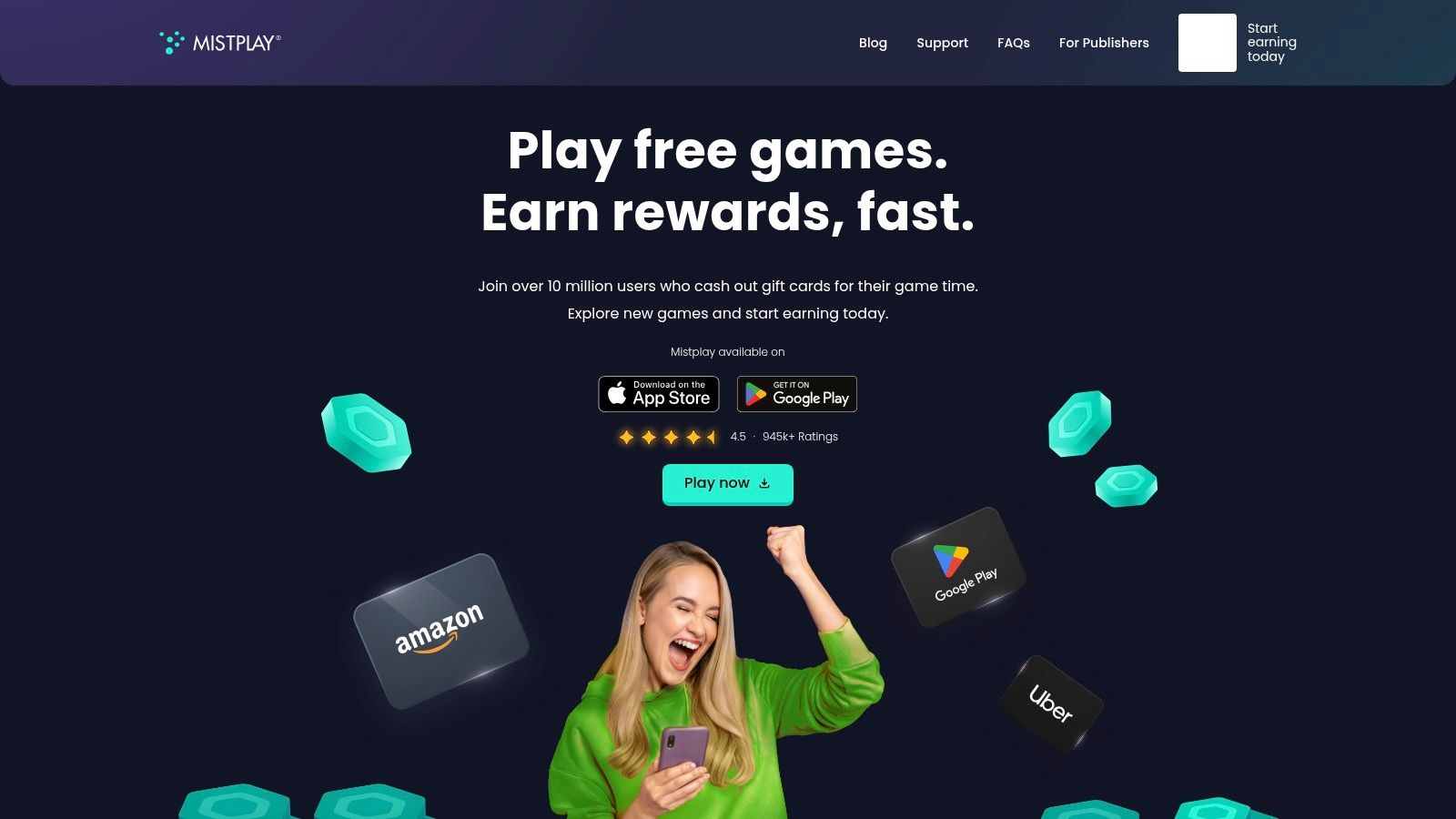
Got mobile games on your phone anyway? Mistplay can turn some of that screen time into gift card rewards, but only if you treat it as casual extra income.
Mistplay rewards playtime and progress in selected mobile games. That sounds simple, and the setup usually is. The catch is that earnings slow down once the easy milestones are gone. If you play just for rewards, the hourly return can get disappointing fast.
I’d only put this in the “worth trying” bucket for people who already like mobile games.
What Mistplay is good for
Mistplay fits a very specific use case. It works best if you want low-pressure earning during spare time and you do not mind being paid in rewards rather than fast cash.
For UK users, check the payout options before you invest much time. Reward apps can change redemption choices by region, and that matters. Bank transfer in GBP is usually more useful than platform-specific vouchers. PayPal is often the easiest option when available, but do not assume every app or reward partner offers it on your account.
Verification can also come up later than people expect. Some platforms ask for email confirmation, phone verification, or ID checks before releasing higher-value rewards. Use your real details from day one so you do not create problems for yourself at payout stage.
The trade-off people miss
The problem is not getting started. The problem is staying efficient.
A new game often pays well at the beginning because the early levels move quickly. Later, progress slows, ads pile up, and you can end up spending another hour to reach a small milestone. That is where people lose money in practice, because they stop thinking about time and start chasing points.
Ask one question before you continue with any game. Would you still play it if the rewards were smaller? If the answer is no, stop early.
How to use Mistplay without wasting time
Keep the process tight:
Test one game at a time: Too many installs make tracking messy.
Give each game a short trial: If it feels repetitive early, it rarely improves.
Check reward terms before you start: Some offers pay for playtime, others for level progress.
Watch in-app spending: Buying upgrades can wipe out any benefit.
Redeem once you hit a sensible threshold: Small, regular cash-outs reduce the risk of losing access to rewards.
Track your hours: A basic note on your phone is enough.
This category works better as entertainment with a small return than as a serious side hustle.
UK points that matter
Tax still counts here. If your total side income goes over HMRC’s trading allowance, you may need to declare it. Keep a simple record with the app name, date, reward value, and how you were paid. Do that even if the payout starts as points and ends as gift cards or cash.
Also check whether the game app drains battery, storage, or mobile data more than you expected. Those costs are easy to ignore because they do not show up as a direct fee, but they still affect what you really get back.
Is it worth it?
Mistplay is fine for people who already play mobile games and want a bit of value back. It is weak if your goal is the highest return per hour.
If you want predictable earning, this will feel slow. If you want a light, low-skill option to use on the sofa, it can do the job. The key is to treat it like paid downtime, not serious income.
7. Use a Modern GPT Hub like Freecash
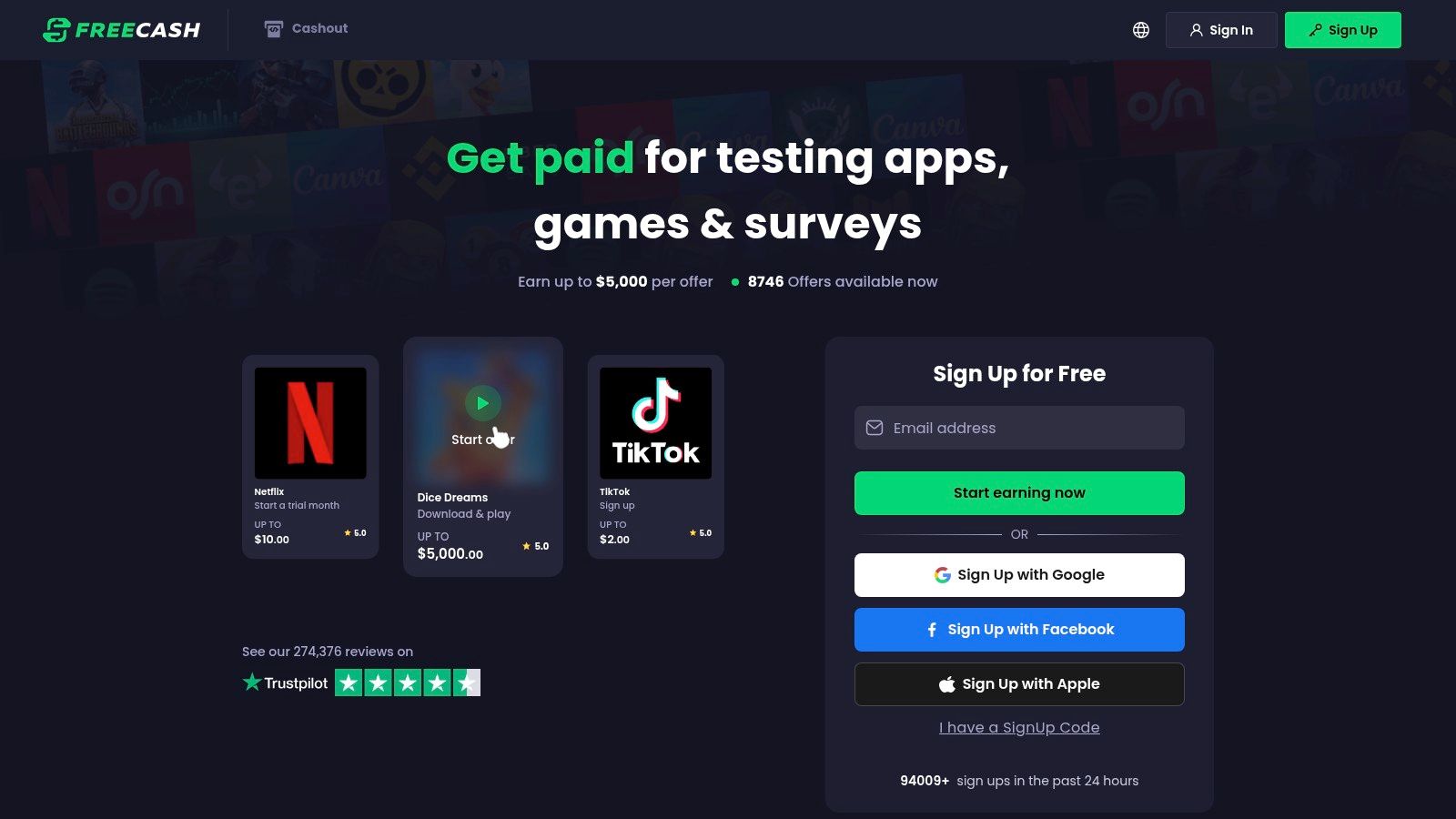
Freecash is a modern GPT platform, short for “get-paid-to,” built around app offers, game milestones, surveys, and partner actions. If older rewards sites feel cluttered, Freecash is one of the cleaner alternatives.
This category overlaps with Klink Finance in some ways, but the user experience can feel different. GPT hubs are usually all about speed, offer walls, and quick visibility into what’s available right now.
Why some users like GPT hubs more than classic survey sites
You’re not locked into one task type. That’s the big appeal.
On a good GPT platform, you can ignore surveys completely and focus on app installs or game progress if that suits you better. That makes the experience feel less repetitive. It also gives you more room to adapt when one category is dry.
The downside is that offer walls can tempt people into doing too much at once. A long list of “easy rewards” looks great until tracking issues, delayed confirmations, and half-finished tasks pile up.
Best way to approach Freecash
Use a shortlist, not a free-for-all.
Pick a few offers based on these questions:
Can I complete this on my current device?
Are the steps clear and realistic?
Does the payout method work for me in the UK?
Would I still do this if the reward took a bit longer than expected?
That last question matters because pending times vary. Some users love fast cashouts on modern GPT hubs. Others get annoyed when specific offers take time to confirm. Both experiences can be true.
A GPT site is only “fast” if the offer tracks cleanly. Speed on the payout screen doesn’t fix bad task selection.
UK trust and compliance points
If you use Freecash or any similar GPT hub from the UK, think beyond the offer list. Check payment options, withdrawal rules, and whether the platform has clear support for missing rewards.
There’s also a broader trust gap in online earning content. UK guides often mention easy payouts but skip tax, fraud risks, and the differences between payment methods. That gap is highlighted by Wise’s discussion of gaps in UK make money online advice. In practice, that means you should keep records, read the payout terms, and be cautious with offers that ask for spending unless you were going to buy anyway.
Used carefully, Freecash can be a solid extra-income tool. Used impulsively, it becomes another pile of unfinished offers.
Top 7 Online Earning Platforms (UK)
Option | Implementation complexity | Resource requirements | Expected outcomes | Ideal use cases | Key advantages |
|---|---|---|---|---|---|
Complete Paid Tasks and Offers with Klink Finance | Low, sign up and complete listed offers | Smartphone/PC, internet, spare time | Supplemental income; variable per activity; real-time tracking; fiat & crypto payouts | Monetize short pockets of downtime; flexible task choice | Flexible offer mix, transparent payouts, fiat & crypto cashouts |
Participate in Academic Research with Prolific | Low–Medium, create profile and qualify for studies | Browser, detailed profile, ID verification | Fair hourly-equivalent pay (min £6/hr); sporadic monthly earnings (£20–£100) | Users who want ethical, academic research participation | Higher pay standards, quality studies, UK-friendly payouts |
Test Websites and Apps with UserTesting | Medium, practice test and recorded sessions required | Computer/smartphone, microphone, quiet space, screen recorder | Higher per-test pay ($10–$120); irregular frequency | Clear communicators comfortable speaking aloud; UX feedbackers | Relatively high per-task payments, live interview options |
Use a Rewards Portal like Swagbucks | Low, immediate access to many activities | Browser/app, time; some offers may require purchases | Low steady earnings (£5–£20/month typical) | Casual earners seeking gift cards or small cashbacks | Huge activity variety, low cashout thresholds, UK retailer options |
Focus on Surveys with Survey Junkie | Low, straightforward survey matching | Browser, time, separate email recommended | Low monthly earnings (£5–£25); transparent points system | Beginners who prefer simple survey tasks | Simple interface, low minimum cashout, PayPal/bank transfer |
Get Paid to Play Games with Mistplay | Low, install and play sponsored games | Android device (iOS limited), playtime, device permissions | Very casual rewards; slow accumulation toward gift cards | Mobile gamers who would play anyway | Earns from existing hobby, game-focused rewards, UK gift cards |
Use a Modern GPT Hub like Freecash | Low–Medium, browse offer walls and complete tasks | Smartphone/PC, time; may require ID for withdrawals | Higher potential if targeting big offers; some users >£100/mo | Strategic users aiming for high-value game or app offers | Fast payouts, varied high-value offers, modern interface |
Your Next Step How to Start Earning Today
What should you do first if you want to earn money online in the UK without wasting hours on weak platforms?
Start smaller than you think. Pick one method. Complete one payout cycle. Then decide whether it deserves more of your time.
The fastest way to get traction is to match the platform to how you already work. Someone with short gaps in the day will usually do better with mobile tasks or surveys. Someone patient and precise may earn more from academic studies. Someone comfortable speaking clearly can often get better rates from website and app testing. If you already spend time gaming on your phone, a rewards app can make that hobby pay a little back.
For beginners, one account with several task types can save time. Klink Finance fits that role. It gives you a way to try surveys, offers, games, and small tasks without opening multiple accounts on day one.
Keep expectations grounded. These platforms are usually for extra income, not a replacement for a wage. The main win is flexibility. You can test what works, cash out early, and cut anything that pays too little for the time involved.
A simple setup works best:
Choose one platform first. Too many sign-ups creates admin without increasing earnings.
Check the payout method before you begin. For UK users, PayPal and bank transfer in GBP are usually the cleanest options.
Verify early. Some platforms ask for email, phone, selfie, or ID checks before withdrawal.
Track time and earnings. A basic note on minutes spent and money received shows which method is worth keeping.
Do a small cashout first. Confirm the payment process works before putting in more effort.
Keep records for HMRC. Platform, date, amount, and payout method is enough for a simple log.
Tax is easy to ignore at the start, but it matters. The HMRC trading allowance lets many casual earners make a small amount before tax reporting becomes an issue. If you go over the allowance, you may need to declare the income. Keep a spreadsheet from the first payout. It takes two minutes and saves hassle later.
Verification also catches people off guard. A payout delay does not always mean a scam. It often means the platform wants identity checks completed before releasing funds. What matters is whether the rules are clear, the checks are explained upfront, and the payment route suits UK users.
My practical advice is simple. Test one platform this week. Aim for your first completed task, study, or usability test, then your first withdrawal. That gives you real evidence. After that, you can scale the methods that feel efficient and drop the ones that drag.
If you want broader inspiration beyond online task platforms, this guide to profitable side hustle ideas for beginners is a useful next read.
FAQs for Earning Money Online in the UK
1. Do I need to pay tax on money I earn online in the UK?
Possibly. The UK trading allowance is £1,000 for this kind of income. If your total goes above that, you may need to report it to HMRC.
2. What’s the easiest method for a complete beginner?
Paid task platforms and survey sites are usually the easiest starting point. They need little setup and work well in short sessions.
3. Can I get paid in GBP?
Often, yes. Check whether the platform offers PayPal, bank transfer, or gift cards that make sense for UK users before you invest much time.
4. Are these methods a replacement for a full-time income? Usually no. They work better as side income. Some methods pay better than others, but they are generally best treated as a supplement.
5. How do I know if a platform is legitimate?
Look for clear payout terms, visible support, transparent tracking, and no upfront fee to join. If you have to pay to access earning tasks, leave.
6. What details do I need to keep for HMRC?
Keep the platform name, date, amount earned, and payment method. That is enough for a basic record.
7. Which option is best if I only have a phone?
Task apps, rewards platforms, gaming apps, and many survey tools work well on mobile. Some website tests and research studies still need a desktop or laptop.
If you want one simple place to start, Klink Finance is a practical option. It lets you test surveys, app offers, games, and small online tasks in one place, with flexible withdrawals and a beginner-friendly setup.


High Quality Offers,
Real Payouts
Start Earning with Klink Now!








Share Article
Related Articles
Read more, Earn more