

Getting paid to play video games from your couch sounds like a dream job, right? It's a real career where your love for gaming can help developers create amazing experiences for players around the world. With more companies hiring remotely, game testing jobs from home are more accessible than ever before.
This guide will walk you through what the job is really like, what skills you need, and how to find legitimate opportunities.
What Is a Remote Game Tester?

Let’s clear up a common myth: game testing isn’t just about playing new games for fun. Think of yourself as a detective, not just a player. Your main goal isn’t to get a high score, but to find, document, and report every problem that could ruin the experience for others.
A big part of the job is trying to break the game on purpose. You’ll do things a normal player wouldn’t, like running into a wall for five minutes or using items in weird combinations to see if it causes a crash. You’re a bug hunter, looking for anything that feels wrong, looks strange, or doesn't work as it should.
Why Is Game Testing Important?
Every bug you find is one less problem for a paying customer. A game that launches with glitches gets bad reviews and can fail. Game testers are the guardians of quality, making sure the final product is stable, polished, and fun. That’s why studios pay for people with a sharp eye for detail.
A game tester’s true skill is in observing, documenting, and communicating. You are the bridge between the developers’ vision and the player’s reality.
The career can be rewarding, too. According to industry data, entry-level testers can start around $38,000 a year. With experience, that can increase to $41,000, and senior positions can earn over $58,000. You can see more about gaming career salaries on Wellfound.
How Do Game Testing Jobs Work?
So, you’re ready to land a game testing job from home? The good news is that you probably already have the basics. It’s more about having the right mindset and a few simple tools than a fancy degree.
Game studios aren’t just looking for someone who loves games. They need people who can analyze them critically and clearly explain what’s wrong. This means having a great eye for detail and the patience to repeat tasks until a bug appears.
Your ability to communicate is just as important. Your job is to write bug reports so clearly that a developer can read them and fix the problem without any confusion.
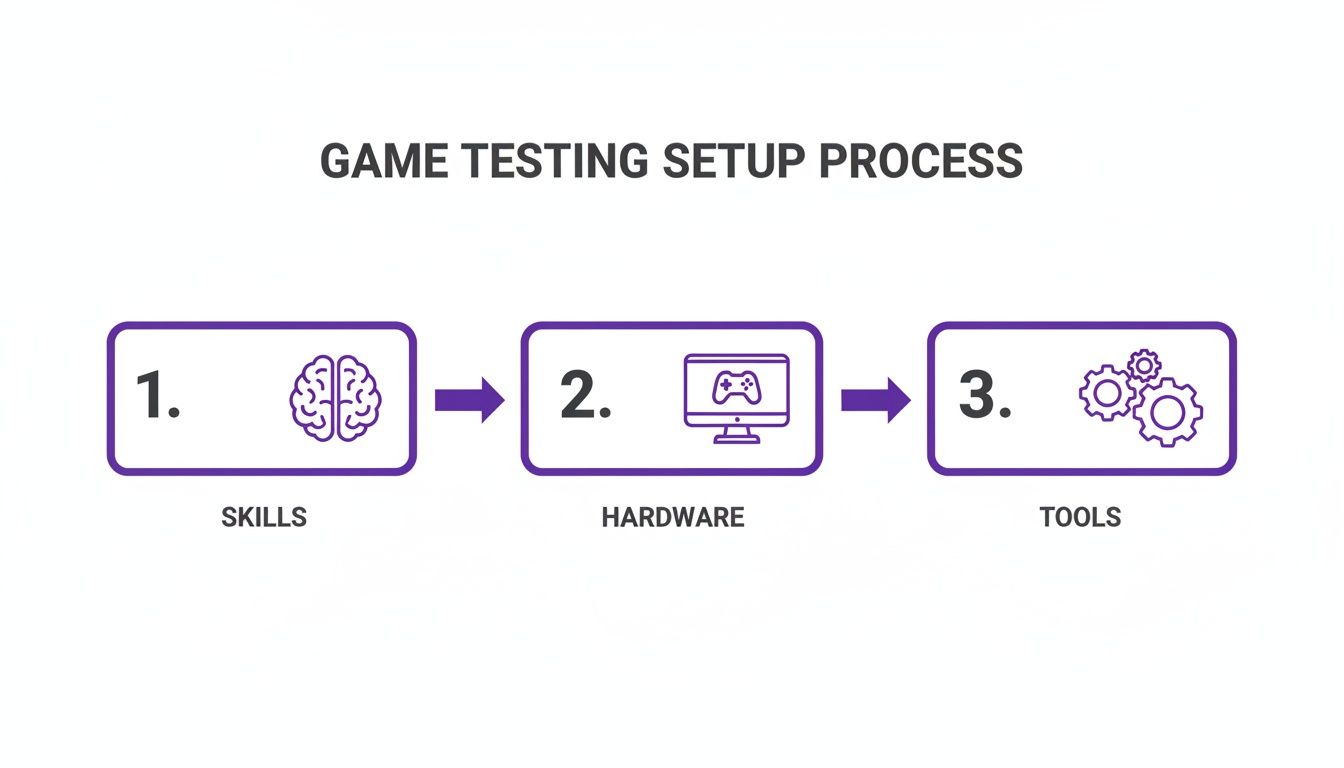
Step 1: Develop the Right Skills
Before we talk about hardware, let’s focus on the skills that really matter. These are your most important tools.
A Keen Eye for Detail: You need to spot the tiny texture error on a character’s armor or the one misspelled word in a long piece of dialogue.
Clear Communication: Writing precise, easy-to-follow bug reports is the core of this job. Vague feedback is useless.
Endless Patience: You might spend an entire day trying to reproduce one single glitch. A patient, methodical approach is essential.
A great bug report tells a story: what you did, what you expected to happen, and what actually happened. For example, a beginner might write, "The gun is broken." A pro would be more specific: "In Level 3, equipping the 'Plasma Repeater' and pressing the right mouse button to aim causes the game to freeze for 2-3 seconds. This happens 100% of the time on PC build v1.0.3." See the difference?
Step 2: Set Up Your Home Lab
You don't need a supercomputer to start, but there are a few essentials for your setup.
A Decent Computer: A reliable PC or Mac that can run modern games is a good starting point for most jobs.
A Stable Internet Connection: This is crucial. You'll be downloading large game files and communicating with your team constantly.
Gaming Consoles (Optional): If you want to test console games, you'll need the hardware. Having a PlayStation 5, Xbox Series X, or Nintendo Switch opens up more opportunities.
You'll also need to get familiar with a few key software tools. Most Quality Assurance (QA) teams use project management tools like Jira or Trello to track bugs. For team communication, they use apps like Slack or Discord.
Step 3: Build a Portfolio

If you’re just starting and don’t have professional experience, don’t worry. You can build a portfolio to show off your skills. This is your chance to show, not just tell. A portfolio with a well-written bug report is proof that you have what it takes.
Join an Open Beta: Many games have open beta tests before they launch. Sign up, play with a purpose, and document any bugs you find. Write them up in a professional format.
Test a Free-to-Play Game: Pick a popular free game and try to find issues with a specific feature, like the crafting system or a character’s abilities. Document your findings.
Write a Usability Review: Choose a game you know well and analyze its user experience. Are the menus easy to navigate? Is the tutorial helpful? Write a short review.
Step 4: Find Legitimate Jobs
Alright, your skills are sharp and your setup is ready. Now it’s time to find real, paying game testing jobs from home. The key is knowing where to look.
There are many opportunities out there. A quick search on Indeed recently showed over 600 remote QA roles, which proves that companies are actively hiring. You can check out the current remote game testing job market on Indeed.com.
Here are the best places to start your search:
Industry-Specific Job Boards: Sites like GamesIndustry.biz or Game Developer are where the professionals go. These are great for seeing what the industry wants.
Freelance Testing Platforms: Platforms like UTest, Testbirds, and BetaFamily are perfect for beginners. They connect you with short-term projects that help you build your portfolio.
Major Job Sites: Don’t forget big sites like Indeed and LinkedIn. Use specific search terms like "QA Tester Remote" or "Entry-Level Game Tester" to find hidden gems.
Step 5: Get Paid

Let's talk about the money. Pay structures for game testing jobs from home can vary, from freelance projects to full-time salaries.
As a beginner, you’ll likely start with freelance work. You might get paid a flat rate for a project, a fee for every bug you find, or an hourly rate. Hourly pay is often between $15 and $30.
As you gain experience, you’ll find different payment options:
Hourly Rates: Common for freelance work. You log your hours and get paid.
Per-Project Fees: A fixed amount for testing a specific game or feature.
Salaried Positions: A full-time job offers a steady paycheck and often includes benefits.
The earning potential can be high. While entry-level jobs pay modestly, experienced testers are in demand. Some specialized remote roles are even advertised with salaries between $270k–$350k. You can see some of these high-paying video game testing roles on Wellfound.
Sometimes, waiting for freelance payments can be slow. If you want to earn money from gaming more casually, you can use platforms that reward you for completing simple tasks. For example, Klink Finance is a global rewards platform where you can try new games and complete offers to earn money right away. We help you monetize your gaming time in a flexible way.
Common Mistakes to Avoid
When you're starting out, it's easy to make a few mistakes. Here are some common pitfalls to watch out for.
Not Being Specific Enough: Vague bug reports like "the game crashed" are not helpful. Always include clear, step-by-step instructions so developers can reproduce the bug.
Ignoring Instructions: Every project comes with a test plan. Make sure you read and follow it carefully. Ignoring it can mean you miss critical issues.
Giving Up Too Easily: Some bugs are hard to reproduce. Don't give up after one try. Patience and persistence are key skills for a successful tester.
Falling for Scams: Be careful! A real company will never ask you to pay for a job or for training. If an offer seems too good to be true, it probably is. Watch out for unrealistic salary promises and unprofessional emails.
By avoiding these common mistakes, you can build a strong reputation and find great opportunities in the world of remote game testing.
FAQs About Game Testing Jobs From Home
1. Do I need a college degree to be a game tester? No, most entry-level game testing jobs do not require a degree. Studios value practical skills like attention to detail, clear communication, and a methodical mindset more than a specific diploma. A strong portfolio is much more important.
2. What kind of computer do I need? You don’t need a supercomputer. A reliable PC or Mac that can run modern games and a stable internet connection are usually enough for many PC and mobile testing jobs. If you want to test console games, you will need the specific console.
3. Are the hours flexible? Yes, one of the biggest benefits is flexibility. You can find full-time, 40-hour-per-week salaried jobs, or you can take on freelance projects and work just a few hours a week as a side hustle. It’s easy to fit the work around your life.
4. Is game testing a good long-term career? Absolutely. It's a great way to start a career in the gaming industry. Many testers move on to become QA Leads, game designers, or producers. The skills you learn are valuable across the entire industry.
5. How much can I earn as a beginner? Entry-level freelance testers can typically earn between $15 and $30 per hour. Salaried positions for beginners usually start around $38,000 per year. Your earnings will grow as you gain more experience and skills.
6. How do I find my first job with no experience? Build a portfolio. Participate in open beta tests, test free-to-play games, and write up your findings in professional bug reports. This shows companies you have the skills and initiative, even without formal job experience.
7. Are there other ways to earn money from gaming? Yes. If you’re not ready for a formal job, you can use platforms that pay you for game-related tasks. For instance, Klink Finance connects you with developers who need people to try new games. It's a casual way to turn your hobby into rewards.
Ready to turn your gaming skills into cash? With Klink Finance, you can earn rewards by playing games, trying new apps, and completing simple tasks. It's the perfect way to get paid for your passion without the commitment of a full-time job. Start earning today with Klink Finance


High Quality Offers,
Real Payouts
Start Earning with Klink Now!









Share Article
Related Articles
Read more, Earn more