
Can you make money from simple online tasks in the UK, or is it just another low-value internet promise?
Yes, you can get paid. The more useful question is how much, how reliably, and in what form. For UK users, that usually means checking whether a site pays in GBP, PayPal, bank transfer, gift cards, or crypto, and whether withdrawals are realistic rather than buried behind awkward limits.
These platforms usually pay for clear, trackable actions. That might be a survey, app test, product trial, game milestone, research study, or partner signup. Brands pay for feedback and user actions. The platform takes a cut and passes the rest on to you.
The money is real, but the range is wide.
Some sites are good for quick, low-effort earnings during spare moments. Others pay better but accept fewer users or send fewer tasks. Prolific, for example, tends to suit UK users who want research studies with clearer pay rates. UserTesting can pay more per task, but spots are limited and you need to pass screeners. Reward apps such as Klink Finance, Swagbucks UK, ySense, and Freecash usually offer more variety, but earnings often come in smaller chunks.
That trade-off matters. High volume often means lower pay per task. Higher pay often means fewer invites, stricter approval, or longer wait times.
If you want a practical primer before choosing a platform, this guide on making money by completing tasks online explains how these task models usually work.
UK beginners should also filter platforms by safety, not just headline earnings. Check the minimum cashout. Check how long approvals take. Check whether support exists when a task tracks incorrectly. If a site promises easy money but hides its payout rules, skip it.
If you want a broader starting point beyond task platforms, this guide on how to make money online with no experience is a useful companion.
Below are seven options that pass a basic practical test for UK users: accessible signup, real payout methods, and a lower chance of wasting time on obvious scams.
1. Klink Finance
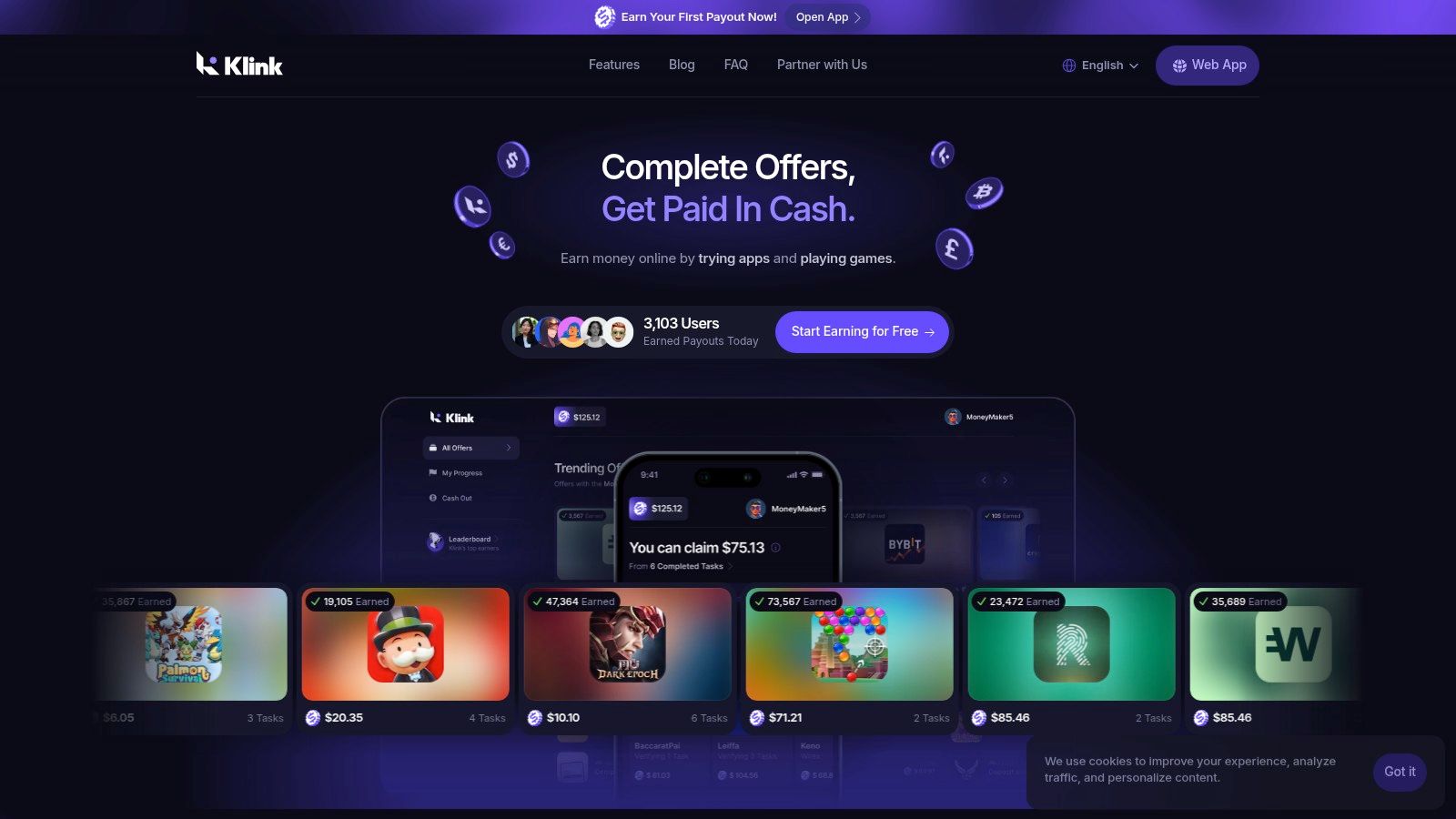
Want one platform that lets you test a few task types without juggling five different apps? Klink Finance suits that job well.
It combines app offers, games, surveys, and other partner tasks in one place. You can use it on web, iOS, and Android, which makes it practical for UK users who want to earn in short sessions on a phone, then check progress later on a laptop.
The main draw is flexibility. Some platforms are built around one task type and one payout route. Klink gives you a mix of earning options and supports withdrawals in different currencies, including GBP. That matters if you want clearer cashout value and fewer conversion headaches.
What Klink Finance does well
Klink is strongest as a general rewards app, not a specialist research platform. If you like switching between surveys, installs, signups, and game-based offers, it gives you more room to pick what fits your time and device.
The dashboard is also easier to work with than many older rewards sites. You can see task progress, pending rewards, and approved earnings without digging through cluttered menus. That saves time, especially when an offer takes a while to confirm.
If surveys are part of your plan, this guide on how to earn money completing surveys gives useful context on what usually pays, what wastes time, and how to choose better offers.
Practical rule: Track every offer you start. Take screenshots of the requirements, reward amount, and completion screen. If a task fails to track, that record gives support something concrete to check.
What UK users should expect
The earning ceiling depends on the offers available that week. Some days will be better than others. Surveys usually pay less but take less effort. App installs and partner promotions can pay more, but they often come with stricter conditions. Games sit in the middle. They can be worth doing if you already like mobile games, but they are rarely the fastest route to cash.
That is the trade-off with this type of platform. You get variety and easy access, but earnings are usually made up of smaller wins rather than one high-paying task.
For beginners in the UK, a few details make Klink easier to test safely:
GBP withdrawals: Useful if you want a clearer view of what your time is worth.
Multi-device access: You can start on mobile and check status elsewhere.
Visible tracking: Pending and approved rewards are easier to follow than on many offerwall-heavy sites.
Mixed task types: Helpful if surveys alone get repetitive or dry up.
Where it can fall short
Offer availability changes. If the better-paying tasks do not match your phone, location, or interests, earnings can slow quickly.
Approval speed also varies by advertiser. Some rewards show up fast. Others stay pending while the partner confirms the action. That is normal for offer-based platforms, but it can frustrate new users who expect instant cashout after every task.
Klink makes the most sense for UK beginners who want a broad starting point, GBP support, and a clearer view of task status than many older rewards sites provide. It is a practical first app if you want to test what pays you best before committing more time.
2. Prolific
Want fewer junk surveys and fewer screen-out loops? Prolific is one of the better options UK users can try.
It focuses on academic studies and structured research projects instead of the usual mix of offerwalls, ad-heavy surveys, and low-value clicks. That changes the experience straight away. You fill in detailed profile questions once, then Prolific uses that information to match you with studies you are more likely to qualify for.
That filter is the main reason people stick with it. Time matters. If a platform keeps sending you into dead-end screening questions, your hourly rate falls fast.
Why it stands out for UK beginners
Prolific is more selective than a standard GPT site. That usually means fewer tasks, but better ones. For UK users, that trade-off often makes sense.
You are more likely to see proper research studies with clear time estimates and stated rewards. That makes it easier to judge whether a task is worth doing before you start. On weaker platforms, you often only find out after several minutes of unpaid screening.
Payment methods are also simple. Prolific is better suited to people who want straightforward cash earnings rather than gift cards, points systems, or crypto options. If your priority is clean survey work in GBP terms, that simplicity helps. If you want broader payout choice, it will feel limited compared with some of the other platforms in this guide.
If you are comparing research studies with app-based tasks, this guide to getting paid to test apps is a useful next read.
The trade-offs
Prolific is not a volume platform. Some users get regular studies. Others wait. Your age, job, education, devices, and household profile all affect what appears in your dashboard.
Speed matters too. Good studies can fill up quickly. If you only check once a day, you will miss some of the better opportunities.
There is also less task variety here. Prolific works well if you like surveys, opinion studies, and research participation. It works less well if you want microtasks, game offers, cashback-style promos, or crypto cashouts.
Best use case
Prolific suits UK users who want a cleaner way to get paid to complete tasks online and are happy to trade quantity for better screening and clearer study information.
A few practical points to keep in mind:
Good for realistic hourly value: Fewer wasted screeners can make earnings feel more consistent.
Better for focused sessions: Check in, claim a study, complete it properly, then log off.
Limited payout flexibility: Good if you want simple cash withdrawals. Less useful if you prefer multiple cashout options.
Safer feeling for beginners: Research-led tasks tend to be easier to judge than offer-heavy reward sites.
Use Prolific if you want better filtering, clearer study quality, and a more practical entry point into paid research in the UK.
3. UserTesting
Want task sites that pay for actual opinions, not just clicks?
UserTesting is one of the clearer examples. You record your screen, follow a brief, and say out loud what you notice as you move through a website or app. That spoken feedback is the whole point. Clients want to hear where you hesitate, what feels confusing, and what makes a process easier or harder to trust.
For UK beginners, the main appeal is simple. A single accepted test can be more worthwhile than a batch of low-value microtasks. The trade-off is consistency. Tests do not appear all day, and you will not qualify for every screener.
Why some users rate it highly
This platform suits people who can explain themselves clearly under light pressure. Good contributors do not perform. They talk naturally, stay on task, and describe what they are seeing in real time.
That makes UserTesting different from survey-heavy sites. The value comes from quality of feedback, not speed alone. If you are patient and reasonably articulate, it can be a better fit than platforms built around endless disqualifications or tiny payouts.
If this style of work appeals to you, this guide to money-making apps in the UK covers a few other routes worth comparing.
What to expect in practice
Treat each test like paid client work. Use a quiet room. Check your microphone. Read the task brief fully before you start speaking. Small mistakes can hurt your rating, and ratings affect what you get shown later.
There is also a real screening bottleneck. You may answer several qualifying questions and get nothing from them. That is normal here. UserTesting works better as a selective, higher-value option alongside something steadier, not as the only site you rely on.
A few practical points:
Best for clear speakers: You need to describe actions and reactions without going silent.
Good earning potential per task: Stronger than many survey sites, but far less predictable.
Usually better on desktop: Some tests are mobile-based, but desktop setups are often easier to complete well.
Payout method matters: Check the current payment options before signing up if you want GBP withdrawals or a specific cashout route.
Keep talking as you work through the test. Dead air makes your feedback less useful.
If you want substance over volume, UserTesting is one of the more practical ways to get paid to complete tasks in the UK.
4. Swagbucks UK
Want one site where you can try surveys, cashback, app offers, and a few low-effort daily tasks without juggling multiple logins? That is the main reason Swagbucks still gets recommended in the UK.
Swagbucks works best as a mixed bag, not a specialist earner. You can pick off short tasks, collect cashback on purchases you were already going to make, and cash out through options UK users are familiar with, including PayPal and gift cards. For beginners, that matters. The platform is familiar, the rewards are easy to understand, and there is usually something available even when one category dries up.
It also suits people who want flexible, low-pressure earning rather than chasing one high-paying task type. If you want more options built around the same kind of casual earning, this guide to money-making apps in the UK is a useful comparison.
Where Swagbucks is useful
Swagbucks is strongest when you use it selectively. Shopping cashback can be worthwhile if you were going to buy anyway. Daily polls, search rewards, and a few partner offers can add a bit more on top. Surveys are available, but they are rarely the best reason to join on their own.
This is also one of the easier platforms for UK beginners to test because the payout methods are tangible. Before spending time on any GPT site, check what cashing out looks like in practice. Gift cards may suit some users. Others will want PayPal or another route that feels closer to cash. That filter matters more than headline earning claims.
The trade-off
The weak point is efficiency. Swagbucks has volume, but not every task is worth doing. Some surveys screen people out after a few questions. Some offers look generous until you read the conditions. Some game and app tasks only make sense if you were going to try them anyway.
That is why I would treat Swagbucks as a filler platform. It is useful for spare minutes and routine offers, not for focused hourly earning.
A practical way to use it:
Prioritise cashback on planned spending: Never buy something just to earn points.
Check payout value before starting: A task that takes 20 minutes for a tiny return is easy to skip.
Be careful with offer walls: Read the terms, tracking rules, and payout timing before you commit.
Use it alongside stronger platforms: Swagbucks is steadier when it is one part of your mix.
One more point on safety. GPT sites attract beginners, which means they also attract exaggerated earning claims. Stick to tasks inside the platform, verify the payout method early, and avoid any offer that asks for money up front or pushes you into spending to "qualify" for rewards.
Swagbucks is a practical option if you want variety, familiar rewards, and an easy entry point. It is less attractive if your goal is strong hourly rates or predictable income.
5. Clickworker
Do you want actual small jobs instead of another queue of survey screen-outs? Clickworker is one of the better-known options for that.
The platform focuses on micro-tasks. That can mean data categorisation, short writing jobs, web research, AI training tasks, or checking information against a set of instructions. For UK users, that makes it a useful filter if you prefer paid work that feels closer to piecework than points collecting.
It also has a different rhythm from GPT sites. You are usually being paid for accuracy and speed, not just for showing up and clicking through offers. Some people like that straight away. Others find it repetitive after a few sessions.
Where Clickworker works well
Clickworker makes the most sense if you are organised, patient, and reasonably fast on a keyboard. Clear task types can be good for short work blocks, especially if you want something you can start and stop without a long setup.
It also fits the pattern many UK users are after. Small, flexible top-ups. Not a second salary.
That distinction matters. Earnings can be decent on the right tasks, but they are not steady enough to treat as reliable weekly income unless you already know which jobs suit you.
The real trade-off
The upside is structure. You get a defined task, a stated payment, and a clear finish point.
The downside is inconsistency. Task availability changes. Some jobs go quickly. Some are not worth the time once you factor in reading instructions, rework, or qualification steps. Your hourly rate depends less on the headline fee and more on how efficiently you complete that specific task type.
This is why beginners often misread Clickworker. They see a list of available jobs and assume the platform is the opportunity. It is not. The opportunity is the small subset of tasks you can complete accurately, fast, and without constant second-guessing.
How to use it without wasting time
A practical approach:
Start with simple task categories: Learn how the platform works before you touch anything fiddly.
Read instructions once, then decide: If a task still feels unclear, skip it.
Track time against payout: A £3 task that takes 25 minutes is different from a £3 task that takes 8.
Notice your best-fit work: Some users do well on writing and categorisation. Others are quicker on data checks.
Keep a backup platform: Dry spells happen, so do not rely on Clickworker alone.
One habit helps more than people expect. Review your completed tasks after a few days and ask a blunt question. Would you do that exact job again at the same rate? If the answer is no, stop forcing it.
Judge Clickworker by your repeatable hourly return, not by how busy the task list looks on day one.
For UK beginners, Clickworker is a credible option if you want task-based work and a more direct link between effort and payout. It is less useful if your main priority is predictable daily availability or a simple cash-out routine above everything else.
6. ySense
Want a backup platform that pays in ways UK users can use, without pretending it will replace a real income? ySense is one of the better-known options for that job.
It sits close to Swagbucks in the general GPT category, but the practical difference is payout choice and how you use it. For UK users, that matters. Some people want GBP through PayPal. Others prefer gift cards or crypto through partner routes on whichever platform they use. ySense works best for people who care about cashing out in a way that fits the rest of their setup, not for people chasing high hourly rates.
Where ySense fits
ySense is mostly surveys, offerwalls, and small online tasks. The earning pattern is familiar. Some days you will find a few decent opportunities. Other days you will hit screen-outs, low-value offers, or long completion times that are not worth it.
That does not make it useless. It makes it a filter job.
The smart way to judge ySense is by what survives your filter. If a survey pays poorly, screens out often, or asks for too much personal detail for too little reward, skip it. If an offer has messy terms or delayed crediting, leave it alone. Beginners often lose time here because they treat every available task as a real opportunity. It is not.
How to use it without wasting hours
A simple approach works best:
Set a minimum rate in your head: If the return looks weak, move on quickly.
Complete your profile properly: Better survey matching can reduce pointless screen-outs.
Check payout methods before you commit: Make sure the withdrawal route suits you in the UK.
Take screenshots of offer terms: Handy if credit goes missing.
Use it as a secondary site: ySense is stronger as extra earning capacity than as your only platform.
One more point matters for beginners. GPT sites and scam task schemes can look similar at a glance. The difference is usually in the details. Real platforms do not ask you to send money first, buy your way into higher earnings, or move conversations to WhatsApp or Telegram to gain access to better tasks. If that happens, leave.
ysense is worth testing if you want another survey-and-offer option with flexible cashout routes. Keep your standards high. Track your time. Treat it as a top-up platform, not a paycheck.
7. Freecash
Need a task site that feels easier to use and pays out in ways that suit UK users?
Freecash stands out for one practical reason. It is built for fast decisions. You can scan offers, see what is pending, and choose from payout methods that are more flexible than many older GPT sites. That matters if you want cash in GBP, crypto, or another option you will prefer to use, rather than being pushed into a gift card you did not want.
The main trade-off is the same one you get with most offer-heavy platforms. Convenience is good. Offer quality still varies. Some app installs, game tasks, and survey routes can be worth doing. Others drag on, track badly, or pay too little for the time involved.
Why it appeals to UK beginners
Freecash is usually easier to learn than clunkier rewards sites. The layout is simple, cashout tends to feel more direct, and the range of withdrawal options is a real plus for UK users who care about flexibility.
That does not make it automatically safe.
Modern task scams often copy the look of legitimate earning apps. A polished dashboard proves very little. What matters is how the platform handles tracking, withdrawals, support, and basic red flags. If you are told to pay first, recruit people to release earnings, or move the conversation onto WhatsApp or Telegram, leave immediately.
How to use it without losing time
Use Freecash as a selective platform, not a place to click everything.
A sensible approach looks like this:
Read the full offer terms first: Check completion steps, tracking windows, and any spend requirement.
Prioritise tasks with clear payout logic: If the conditions are vague, skip it.
Screenshot higher-value offers: Useful if a reward does not credit properly.
Test a small cashout early: Confirm the withdrawal method works for you in the UK before investing more time.
Drop any offer that keeps adding hoops: Delays happen. Escalating requirements are a different issue.
Freecash is a good fit for beginners who want a cleaner GPT experience and flexible payout routes. Keep expectations realistic. Treat the better offers as extra income, and treat your scam filter as part of the job.
7-Platform Comparison: Get Paid to Complete Tasks in the UK
Platform | Implementation complexity | Resource requirements | Expected outcomes | Ideal use cases | Key advantages |
|---|---|---|---|---|---|
Klink Finance | Low, quick signup on web/iOS/Android | Mobile/desktop time for offers; no special skills | Modest for casual users (~£80+/mo reported); higher if very active; variable by location | Side-hustle for students, mobile gamers, casual earners | Flexible payouts (20+ currencies), real-time tracking, direct brand offers |
Prolific | Low, account + detailed prescreener setup | Time for academic-quality surveys; demographic fit matters | Typically higher hourly equivalent than many survey sites; study availability varies | Users who prefer higher-quality research studies and fair pay | Research-focused studies, clear eligibility, reputable pay practices |
UserTesting (Contributor Network) | Medium, application and sample test often required | Quiet space, good microphone, clear spoken English; 15–20 min per test | High per-test payouts (~£8–£10 for short tests); occasional higher-paid live sessions | People comfortable speaking feedback and seeking higher short-term pay | High per-task pay, direct influence on product design, on-demand tests |
Swagbucks (UK) | Low, easy signup and many entry-level tasks | Varied tasks across devices; casual daily time investment | Low-to-moderate steady earnings; rewards via PayPal or gift cards | Casual earners wanting diverse ways to earn and UK-specific rewards | Very broad task variety, long-standing trusted platform, UK rewards store |
Clickworker | Medium, profile tests/assessments unlock tasks | Fast typing, attention to detail, short focused sessions | Variable; depends on task availability and individual speed | People who prefer short micro-tasks (data labelling, transcription) | Reliable micro-task marketplace, diverse AI/data-related tasks |
ySense | Low, simple signup; verification may be needed for cashout | Time for surveys and offerwalls; possible ID/address verification | Low-to-moderate; similar to other survey-heavy platforms | Users who want survey offers with multiple cashout methods | Multiple payout options (PayPal, Skrill, Payoneer), backed by Prodege |
Freecash | Low, quick signup; some features require verification | Mobile/desktop time for surveys, app installs, games; possible ID checks | Fast small payouts with low thresholds; rates fluctuate by offer | Users wanting fast access to earnings and diverse payout options (incl. crypto) | Wide payout options (gift cards, crypto, PayPal), low minimums, fast processing |
Your Plan for Earning Extra Income
What does a realistic plan look like if you want to get paid to complete tasks in the UK without wasting hours on low-value offers or walking into a scam?
Treat this like a small income stream, not a lucky break. The people who get steady results usually follow a simple system. They use a few platforms that fit their time, cash out early to confirm the payout method works, and focus on tasks that pay fairly in GBP, PayPal, or another method they want to use. That matters more than chasing inflated earning claims.
A sensible target is modest, consistent extra income. Some weeks will be stronger than others. Task volume changes. Screen-outs happen. Higher-paying studies fill fast. That is normal.
Tips to boost your task earnings
Consistency beats intensity. Ten to twenty minutes in the morning and again later in the day often works better than one long session at the weekend. You see fresh studies sooner, and you waste less time scrolling dead offers.
Keep your setup tight. Two or three platforms is enough for many UK users. A practical mix is:
One research-led platform: Good for better hourly rates when you qualify
One broad rewards site: Useful for surveys, offers, and smaller daily earnings
One testing or micro-task platform: Good for short bursts of focused work
A few habits make a real difference:
Fill in profiles carefully: Matching drives survey invites, studies, and test eligibility
Test cashout early: Confirm the payout method, threshold, and timing before you build a balance
Track your best task types: Short usability tests may beat surveys for one person, while another does better with app offers or data tasks
Skip poor-value work: A task that looks easy can still pay badly for the time involved
Use bonuses properly: Referral offers, streaks, and promo windows can improve low-to-mid paying platforms
I would also separate “easy” from “worth doing.” Plenty of tasks are simple. Fewer are worth your time after screen-outs, delays, and payout limits.
How to stay safe and avoid scams
Beginners in the UK frequently lose money or time. Scam apps and fake task sites copy the look of real platforms, show fake balances, and then push users toward deposits, VIP upgrades, or “release fees” before withdrawal.
The basic rule is simple. Real task platforms pay you. They do not ask you to pay first.
Use this filter before you spend serious time on any site:
Check the payout methods: Clear options such as GBP bank transfer, PayPal, or established crypto payouts are easier to assess than vague wallet systems
Read the withdrawal rules first: Minimum cashout thresholds, verification checks, and hold periods should be easy to find
Search for outside feedback: Reviews and forum discussions help, but read them critically and look for repeated complaints about non-payment
Avoid any upfront fee: No legitimate survey site or testing platform needs a deposit to let you work
Read offer terms before you start: This matters a lot for games, installs, and milestone-based tasks
Keep screenshots: They help if tracking fails or a reward is marked incomplete
You also need to watch for pressure tactics. If a site promises fixed daily income, guaranteed commissions, or “premium” task tiers that require payment, leave it alone. That pattern is common in task scams.
Don’t ignore tax
Task income is still income. If you earn regularly, keep a basic record from the start. Note the date, platform, amount, and payout method. It takes minutes now and saves a lot of hassle later.
In the UK, earnings over the £1,000 trading allowance can trigger Self Assessment obligations, as explained in Indeed’s guidance on micro-jobs. Even below that level, clean records are a good habit.
The practical approach is straightforward. Pick one or two platforms that match how you want to get paid. Prioritise sites with clear withdrawal rules. Favour better-paying studies and tests over endless low-value clicking. Then review your results after a month and cut anything that is wasting your time.
If you also want to think beyond quick task earnings, this piece on upskilling and advancing your career is a smart next step.
FAQs About Getting Paid for Tasks
1. Can I really get paid to complete tasks in the UK?
Yes. Legitimate platforms pay users for surveys, app testing, market research, game offers, and small online actions. The key is choosing established platforms and avoiding any site that asks you to pay first.
2. Which type of task usually pays better?
Research studies and usability tests often beat generic surveys on a per-task basis. General reward platforms usually offer more volume, but many individual tasks pay less.
3. Should I use one platform or several?
Several is usually better. One research site plus one broader rewards platform is a practical setup because task availability changes from day to day.
4. Do I need a laptop, or can I do this on my phone?
You can do a lot from your phone, especially surveys, games, app offers, and quick tasks. A laptop helps for some research studies, usability tests, and micro-work.
5. What’s the biggest red flag in a task app?
Any request for upfront payment is a major warning sign. So are “premium task” deposits, vague withdrawal rules, and promises that sound wildly unrealistic.
6. Are gift cards better than cash payouts?
Cash is usually more flexible. Gift cards can still be useful if you already spend regularly with a retailer and the redemption value makes sense for you.
7. Do I need to think about tax on task earnings in the UK?
Yes. If your earnings go beyond the trading allowance, you may need to report them. Keep basic records from the start so you’re not guessing later.
If you want a simple place to start, Klink Finance is a good beginner-friendly option. It gives you one platform for surveys, app offers, games, and social tasks, with clear tracking and flexible withdrawals that work well for UK users who want extra income without overcomplicating the process.


High Quality Offers,
Real Payouts
Start Earning with Klink Now!








Share Article
Related Articles
Read more, Earn more