•
10 Proven Mobile App Marketing Strategies for Explosive Growth in 2026
Sunday, February 15, 2026
Share Article
In the crowded digital marketplace, launching a mobile app is just the first step. The real challenge lies in getting it discovered, downloaded, and used consistently. Effective mobile app marketing strategies are no longer optional; they are the engine of sustainable growth. This comprehensive guide moves beyond generic advice to provide a detailed roundup of ten powerful, actionable tactics that top apps use to dominate their categories.
We'll explore everything from cost-effective user acquisition and App Store Optimization (ASO) to advanced retention techniques and community building. Each strategy is broken down with practical examples, key performance indicators (KPIs), and specific insights on how performance-based platforms can supercharge your efforts.
For example, we will discuss how platforms like Klink Finance, a global rewards platform for users to earn money by completing simple tasks, connect app developers with a global network of users looking to earn cash and other rewards for completing tasks, such as testing apps and engaging with new features. This performance-based model ensures you only pay for tangible results like installs or specific in-app actions, making your marketing budget incredibly efficient.
This listicle is designed to be your go-to resource for building a robust marketing plan. We will cover a diverse range of strategies, including:
Performance-Based User Acquisition (CPA Marketing)
Gamification and Rewards Mechanics
Community Building and Social Proof
App Store Optimization (ASO)
Referral and Affiliate Marketing
Data Analytics and User Segmentation
Whether you're a startup on a tight budget or an established player aiming for market leadership, this roundup delivers the blueprint you need to connect with your target audience, drive meaningful engagement, and achieve lasting success. Let’s dive into the strategies that will define app growth.
1. Performance-Based User Acquisition (CPA Marketing)
Performance-based user acquisition, often called Cost Per Action (CPA) marketing, is one of the most efficient mobile app marketing strategies available. Instead of paying for impressions or clicks that may not lead to results, you only pay when a user completes a specific, valuable action. This could be an app install, a registration, a tutorial completion, or even an in-app purchase.
This model eliminates the guesswork and financial risk of traditional advertising. Your marketing budget is directly tied to tangible outcomes, ensuring a clear and measurable return on investment (ROI). It's a data-driven approach that prioritizes conversions over vanity metrics, making every dollar spent accountable.
How CPA Marketing Works in Practice
Platforms like Klink Finance are built on this model. They connect app developers with a motivated audience ready to engage. Developers set the action they want users to complete, and Klink offers a reward to its users for doing so. This creates a win-win: developers acquire high-intent users at a predictable cost, and users are compensated for their time and engagement.
For example, a gaming app like Mobile Strike might partner with a CPA network to pay for every new user who installs the game and completes the first level. This ensures they acquire players who are genuinely interested, not just casual browsers. Understanding the true profitability of your acquisition efforts requires a clear grasp of your cost per conversion, a metric that CPA marketing makes transparent.
Actionable Tips for CPA Success:
Define Clear Actions: Be specific about what constitutes a successful conversion. Is it just an install, or a sign-up with a verified email? Clear definitions prevent ambiguity.
Implement Fraud Detection: Use advanced tools to identify and block fraudulent installs or actions. This protects your budget and ensures you’re paying for real, quality users.
Test Incentives: Experiment with different reward levels to find the sweet spot that maximizes conversion rates without overspending.
Tier Your Rewards: Create a tiered structure to encourage deeper engagement. Offer a small reward for an install, a larger one for reaching level 5, and the highest reward for making a first purchase.
2. Gamification and Rewards Mechanics
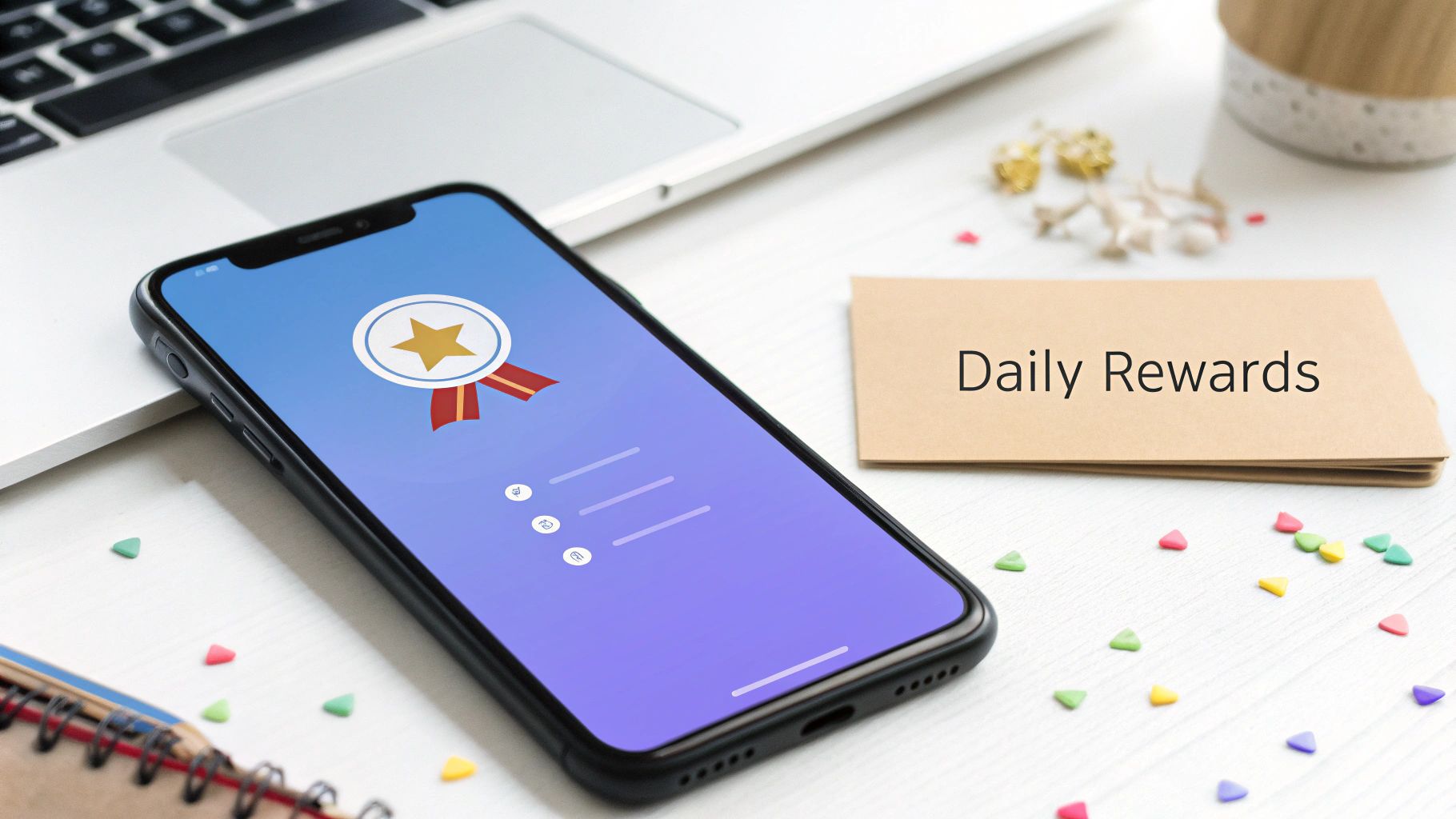
Gamification is a powerful behavioral psychology-driven strategy that integrates game-like elements into non-game apps to boost user engagement and retention. By incorporating features like points, badges, leaderboards, and daily challenges, developers can transform routine app interactions into a more compelling and rewarding experience, encouraging users to return frequently.
This mobile app marketing strategy taps into our natural desire for achievement, competition, and reward. It creates a positive feedback loop where users feel a sense of progress and accomplishment, making the app more "sticky" and turning usage into a consistent habit.
How Gamification Works in Practice
Platforms like Klink Finance, which offers a global rewards platform for users to earn money by completing simple tasks, use gamification to make earning money feel more like playing a game. By presenting tasks within a framework of leaderboards and daily earning challenges, they motivate users to complete more offers. This turns task completion into an engaging habit loop, encouraging users to return daily to climb the ranks and unlock special bonuses.
A classic example is Duolingo, which uses a streak system, achievement badges, and league tables to motivate users to practice a language every day. The fear of losing a long streak or dropping down a league is a powerful motivator that drives exceptional user retention and has become a core part of its brand identity.
Actionable Tips for Gamification Success:
Design Addictive Reward Schedules: Use variable-ratio reinforcement, like unpredictable bonuses or mystery boxes, to keep users hooked. The uncertainty of the reward is highly compelling.
Balance Competition and Cooperation: Offer both leaderboards for competitive users and team-based challenges for those who prefer to collaborate. This caters to a wider audience.
Refresh Challenges Regularly: Introduce new weekly or monthly challenges to prevent monotony and maintain a sense of novelty and excitement within the app.
Use Strategic Push Notifications: Remind users of their streak milestones, expiring rewards, or new challenges to prompt them to re-engage with the app.
3. Community Building and Social Proof
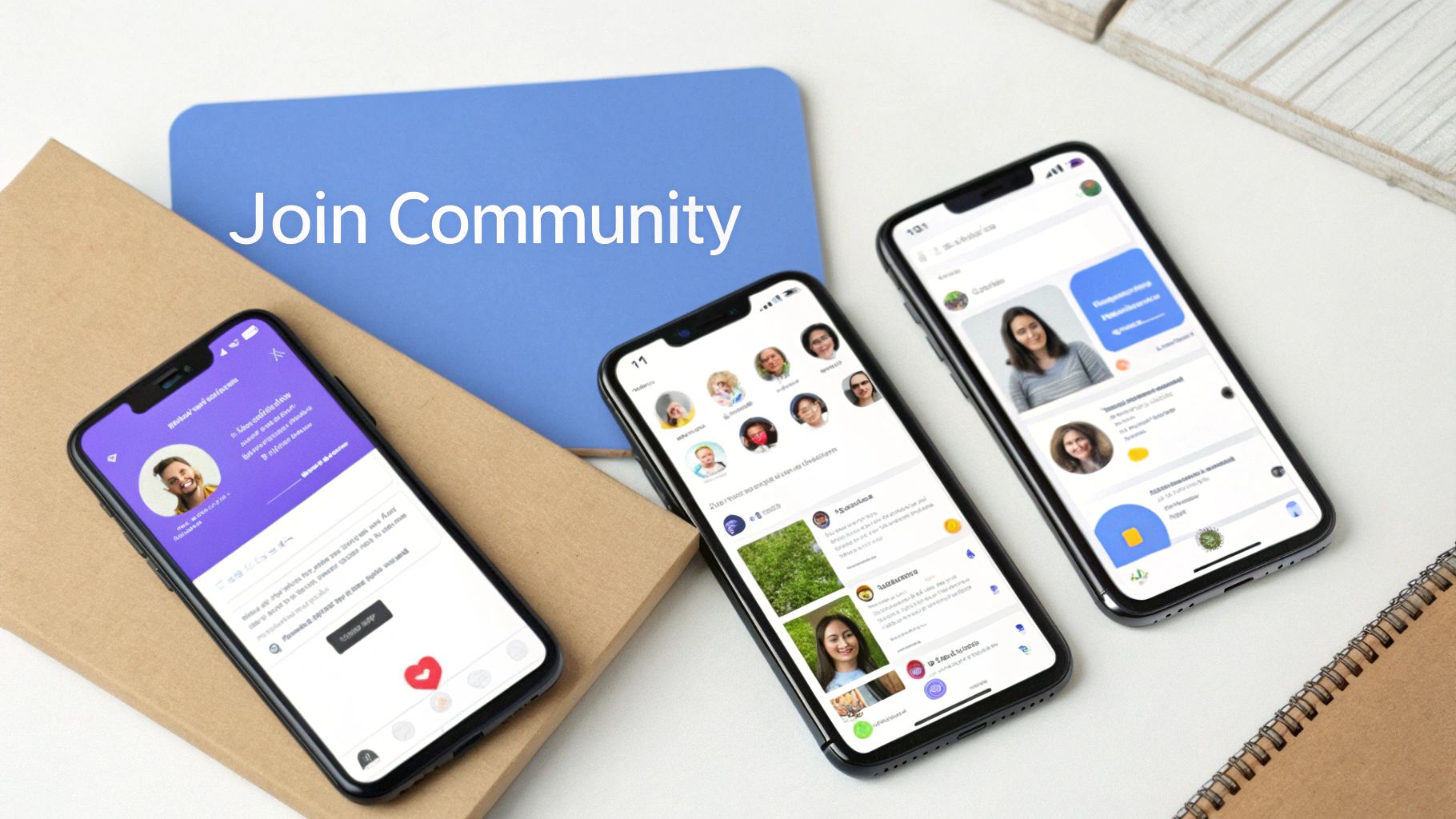
Building an engaged community is a powerful mobile app marketing strategy that fosters organic growth and long-term loyalty. This approach focuses on creating dedicated spaces on platforms like Discord, Telegram, or Twitter where users can connect, share experiences, and feel a sense of belonging. The social proof generated by an active, vocal community builds immense trust and credibility, turning early adopters into your most effective brand advocates.
This strategy creates a self-sustaining growth loop. New users see a vibrant community and are more likely to join, driven by a fear of missing out (FOMO) and the validation of their peers. For platforms like Klink Finance, where users earn rewards for completing tasks, an active community sharing success stories and tips directly fuels user acquisition and deepens engagement with the app.
How Community Building Works in Practice
The core idea is to move beyond one-way communication and cultivate a two-way dialogue. Instead of just broadcasting marketing messages, you facilitate conversations and build relationships. This creates a valuable feedback channel and a strong support network that can significantly reduce user churn.
For example, Notion's explosive growth was heavily influenced by its community, where users actively create and share templates and guides. Similarly, Klink Finance fosters vibrant Telegram and Twitter communities where users share daily earning updates and strategies. This peer-to-peer validation is far more persuasive than traditional advertising, as it comes from a trusted, authentic source: other users.
Actionable Tips for Community Success:
Assign Dedicated Managers: Have a dedicated team member responsible for daily engagement, answering questions, and sparking conversations to keep the community active.
Run Weekly AMAs: Host "Ask Me Anything" sessions with your team to build transparency and give users a direct line of communication, making them feel heard and valued.
Incentivize User Content: Offer community-only bonuses or rewards for users who create helpful content, such as tutorials, reviews, or success stories.
Feature Top Members: Publicly celebrate your most engaged community members and their achievements. Highlighting top earners can inspire aspirational behavior in others.
Create Exclusive Channels: Establish private channels for top performers or early adopters. This creates a sense of exclusivity and rewards your most loyal users.
4. Influencer and Micro-Influencer Partnerships
Partnering with influencers is one of the most powerful mobile app marketing strategies for building trust and reaching niche audiences authentically. Instead of broadcasting a corporate message, this strategy leverages the credibility of content creators to demonstrate your app’s value. Influencers, particularly micro-influencers with 10,000 to 100,000 followers, can generate genuine excitement and drive high-quality installs from their dedicated communities.
This approach bypasses the skepticism often associated with traditional ads. When a trusted creator shows how an app solves a problem or adds value to their life, their followers listen. This social proof is invaluable for building early momentum and establishing your app's reputation within specific, highly-engaged market segments.
How Influencer Marketing Works in Practice
The core idea is to find creators whose audience perfectly matches your target user base. Platforms like Klink Finance, which is a global rewards platform where users can earn money by completing simple tasks, can partner with influencers in the "side hustle," personal finance, or student life niches. These creators can produce tutorials, earnings proof videos, or "day in the life" content showing how they use the app to monetize their spare time.
For example, a TikTok creator focused on helping students earn extra money could create a video showcasing how they earned their first payout on Klink during study breaks. This type of content feels less like an ad and more like a helpful tip, building credibility and driving downloads from an audience that is already looking for such opportunities. It connects your app directly to the user's goals.
Actionable Tips for Influencer Success:
Prioritize Micro-Influencers: Focus on creators with 10,000-100,000 followers. They often have higher engagement rates, a more dedicated community, and are more cost-effective than mega-influencers.
Use Performance-Based Payouts: Structure deals using affiliate links or performance-based models. This incentivizes creators to drive actual results, like installs or sign-ups, not just views.
Encourage Authenticity: Provide creators with honest talking points but avoid overly restrictive scripts. Their unique voice and genuine experience with your app will be far more persuasive.
Create an Onboarding Kit: Make it easy for creators to succeed by providing a simple kit with key features, brand assets, testimonials, and answers to frequently asked questions.
5. App Store Optimization (ASO)
App Store Optimization (ASO) is the organic engine of mobile app marketing strategies. It’s the process of improving an app's visibility within the Apple App Store and Google Play Store to increase organic downloads. By optimizing elements like your app title, keywords, and creative assets, you can rank higher in search results and capture high-intent users actively looking for an app like yours.
Think of ASO as SEO for mobile apps. A well-executed ASO strategy can drive a significant portion of your total downloads without any paid advertising spend. It's a foundational tactic that ensures your app gets discovered by the right audience at the exact moment they need it, boosting long-term, sustainable growth.
How ASO Works in Practice
The goal of ASO is to convince both the app store algorithms and potential users that your app is the best result for their search. This involves technical optimization (keywords) and creative optimization (visuals and text). For example, Klink Finance, a global rewards platform for users to earn money by completing simple tasks, optimizes its listing for terms like "earn money app" and "task app" to appear at the top when users search for ways to monetize their spare time.
Similarly, an app like Duolingo has achieved a dominant position in the education category by continuously refining its ASO. They target broad keywords like "learn languages" and niche ones like "learn Spanish for free," ensuring they capture users at every stage of their search. This comprehensive approach keeps them ahead of competitors and reduces their reliance on paid user acquisition.
Actionable Tips for ASO Success:
Target Long-Tail Keywords: Instead of competing for broad terms, focus on more specific phrases with lower competition, such as "earn rewards by completing tasks."
Optimize Creative Assets: Create multiple variations of screenshots and video previews that highlight different value propositions, like user testimonials or proof of earnings.
Encourage & Manage Reviews: Actively prompt satisfied users to leave positive reviews and respond professionally to all feedback, especially negative comments, to show you are engaged.
Refresh Your Listing: Update your app description and keywords quarterly to align with new features, seasonal trends, and evolving user search behavior.
6. Referral and Affiliate Marketing
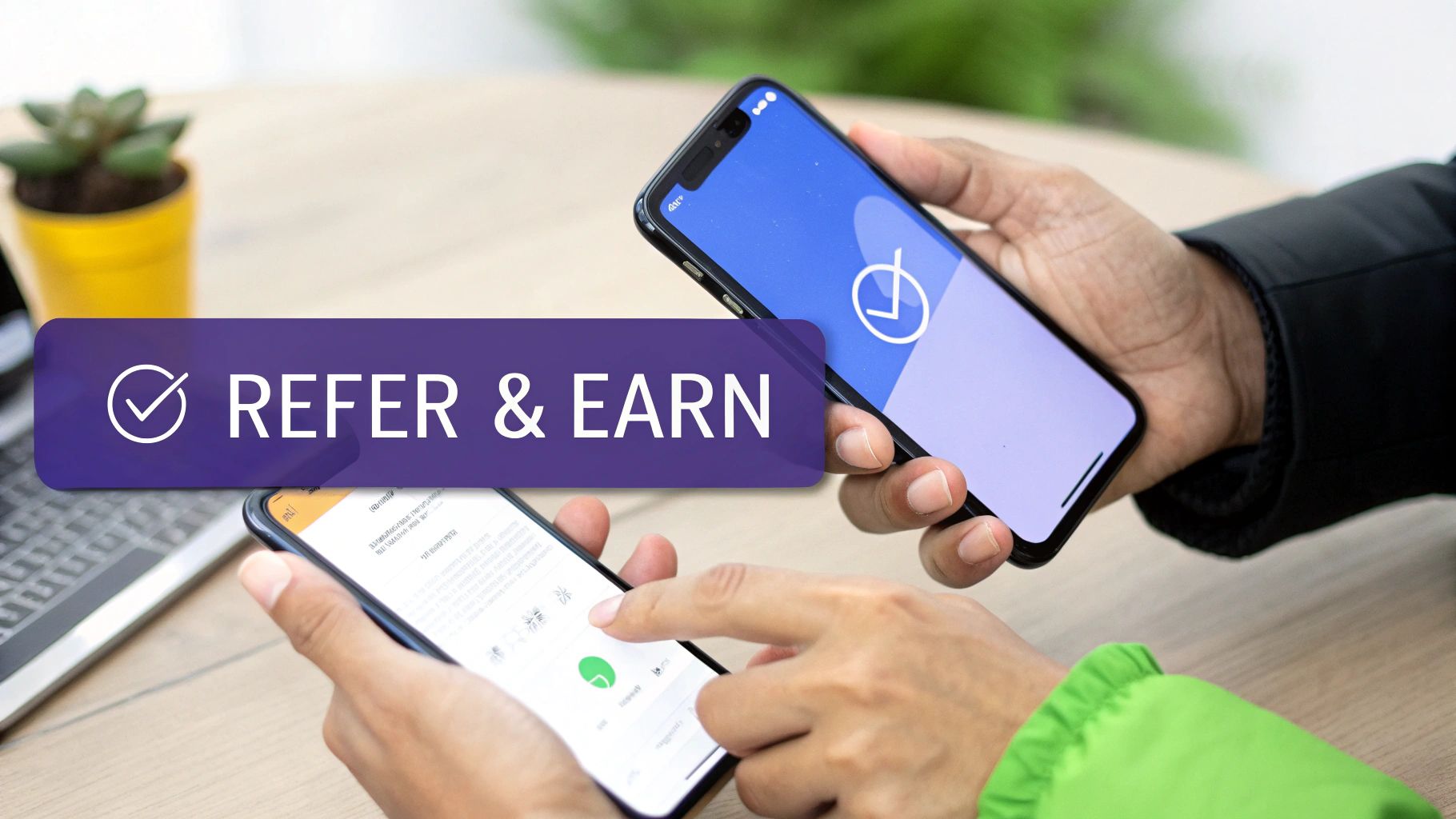
Referral and affiliate marketing are powerful mobile app marketing strategies that turn your existing users into brand advocates. This approach incentivizes your user base to refer friends, family, and followers using unique codes or links, creating a viral growth loop. It leverages the network effect, where each new user becomes a potential channel for acquiring even more users through trusted, word-of-mouth recommendations.
This model is exceptionally effective because it capitalizes on social proof. A recommendation from a friend is far more persuasive than a traditional advertisement. By rewarding both the referrer and the new user, you create a compelling reason for people to share your app, dramatically lowering your customer acquisition costs and fostering a loyal community from day one.
How Referral Marketing Works in Practice
Platforms that reward users, like Klink Finance, often have referral programs built into their core experience. Klink’s model, which connects app developers with a global audience looking to earn rewards, is perfectly suited for referrals. Users are already motivated by earning, so incentivizing them to refer friends who also want to earn creates a highly effective and self-sustaining growth engine.
A classic example is Dropbox, which offered users extra storage space for each friend they referred who signed up. This simple, dual-sided incentive led to a 500% increase in signups and was key to their explosive early growth. Similarly, Uber's program offering free ride credits to both parties helped it rapidly expand into new cities worldwide.
Actionable Tips for Referral Success:
Offer Dual-Sided Incentives: Reward both the referrer and the new user. This makes the invitation feel like a genuine gift rather than a purely selfish act, significantly boosting conversion rates.
Make Sharing Frictionless: Integrate one-click sharing options for social media, email, and messaging apps. Pre-populate the message to make it as easy as possible for users to spread the word.
Implement Fraud Detection: Use device fingerprinting and IP analysis to prevent users from creating fake accounts to abuse the referral system and protect your marketing budget.
Create Tiered Rewards: Encourage power referrers by offering bigger rewards as they hit milestones. For instance, offer a larger bonus for every 10 successful referrals compared to a single one.
7. Push Notification and In-App Messaging
Acquiring a user is only half the battle; retaining them is what builds a sustainable app business. Push notifications and in-app messaging are among the most powerful mobile app marketing strategies for driving retention and re-engagement. These direct lines of communication allow you to bring users back into your app with timely, relevant, and personalized messages.
This strategy is crucial because mobile apps live or die by their daily active users (DAU). A well-timed notification can be the difference between a user who opens your app daily and one who forgets about it after the first use. By reminding users of value, milestones, or time-sensitive opportunities, you build a habit and keep your app top-of-mind.
How Push Notifications Work in Practice
Platforms like Klink Finance, a global rewards platform where users can earn money by completing simple tasks, use this strategy to maximize user engagement and earning potential. When a new high-value task becomes available, Klink can send a push notification to alert eligible users. This not only provides immediate value to the user but also helps Klink’s partners achieve their acquisition goals faster by driving a surge of activity.
Similarly, the language-learning app Duolingo is famous for its streak notifications. These simple reminders encourage users to complete a daily lesson to maintain their progress, a tactic that has been instrumental in achieving its impressive user retention rates. The goal is to deliver the right message to the right person at the right time, turning a passive user into an active participant.
Actionable Tips for Notification Success:
Segment Your Audience: Group users by their behavior and engagement level. Send a "we miss you" offer to a dormant user and a "new challenge" notification to a power user.
Personalize with Dynamic Content: Go beyond using a first name. Include specific user data like, "You're only 3 tasks away from your next payout!" to make messages highly relevant.
Test and Optimize Send Times: Analyze historical user data to determine when your audience is most likely to engage. Send notifications during these peak windows for maximum impact.
Maintain a 3:1 Value Ratio: For every promotional message you send, make sure you send at least three that offer pure value, such as tips, progress updates, or milestone celebrations.
Create Urgency with Timers: For limited-time offers or tasks, include a countdown timer directly in the notification (e.g., "High-paying survey available for the next 2 hours!") to encourage immediate action.
8. Content Marketing and SEO
Content marketing and Search Engine Optimization (SEO) are long-term mobile app marketing strategies focused on creating valuable, relevant content that attracts users organically through search engines like Google. Instead of paying for every click, you build a sustainable asset that draws in users who are actively searching for solutions your app provides. This builds brand authority, trust, and a consistent flow of high-intent traffic.
For an app, this means creating content that answers your target audience’s most pressing questions. This strategy positions your brand as a trusted resource, capturing users at the very beginning of their journey. It’s an investment in building a durable marketing channel that pays dividends long after the content is published.
How Content Marketing and SEO Work in Practice
Platforms like Klink Finance, a global rewards platform where users can earn money for completing simple tasks, leverage this strategy by creating blog posts and guides that appeal to individuals searching for ways to earn online. By creating articles on topics like "top side hustles" or "how to earn rewards from your phone," Klink attracts users who are already motivated to engage with their platform. They aren't just acquiring users; they are educating them on how to succeed.
Another powerful example is NerdWallet, which dominates personal finance keywords by providing exhaustive, trustworthy content. They answer nearly every conceivable question about credit cards, loans, and banking, attracting millions of organic visitors who are prime candidates for the financial products they recommend. This content-first approach has made them a household name.
Actionable Tips for Content and SEO Success:
Target Long-Tail Keywords: Focus on specific, less competitive phrases like "how to earn $50 a day from your phone" instead of broad terms like "make money." These attract a more qualified audience.
Build Topic Clusters: Create a main "pillar" page on a broad topic (e.g., "Earning Rewards Online") and link it to more specific "cluster" articles (e.g., "Best Apps for Surveys," "Getting Paid to Play Games").
Create Linkable Assets: Develop original research, case studies, or free tools that other websites will want to link to. This builds your site's authority and improves search rankings.
Optimize for E-E-A-T: Ensure your content demonstrates Experience, Expertise, Authoritativeness, and Trustworthiness, which are key ranking factors for Google, especially in financial topics.
9. User Onboarding and Activation Optimization
The first few moments a user spends in your app are the most critical. User onboarding and activation optimization focuses on designing a frictionless initial experience that guides new users to their first "aha!" moment as quickly as possible. Since 25% of users abandon an app after just one use, a seamless onboarding flow is a make-or-break mobile app marketing strategy for long-term retention.
This strategy is about converting a download into an active user. The goal is to eliminate every point of friction that could cause a user to drop off before they experience your app's core value. For platforms built on user engagement, this means showing them how to get what they came for immediately, solidifying the app's place in their daily routine.
How Onboarding and Activation Works in Practice
Exceptional onboarding is the key to demonstrating value. For an app like Klink Finance, a global rewards platform where users join to earn money for completing simple tasks, the "aha!" moment is receiving their first payout. Therefore, the entire onboarding process is designed to speed up the user's path to completing their first rewarded task. Every unnecessary form field or verification step is a risk that exponentially reduces completion rates.
Consider Duolingo, which gets users into their first language lesson in under five minutes, driving an impressive day-one engagement rate. Similarly, Cash App's simple phone-number signup drastically reduces friction, getting users to the activation point (sending or receiving money) almost instantly. These apps understand that the initial experience dictates future engagement.
Actionable Tips for Onboarding Success:
Remove All Non-Essential Fields: Ask only for the absolute minimum information required for signup. Collect additional details progressively as the user engages more deeply with the app.
Implement One-Tap Social Logins: Use familiar options like Google or Apple to make account creation instant and effortless, removing the need to create new passwords.
Guide to the First Action: Immediately after registration, direct the user to a high-value task. A tutorial that guides them to their first earning opportunity is far more effective than static welcome screens.
Offer a Welcome Bonus: Incentivize the completion of the first task by offering a small welcome reward, like a bonus credit. This provides an immediate taste of the app's value.
A/B Test Your Flow: Continuously test different onboarding sequences, welcome messages, and tutorial styles to identify the path with the highest activation rate.
10. Data Analytics and User Segmentation
Data analytics and user segmentation are foundational mobile app marketing strategies that move you from guessing to knowing. Instead of marketing to your entire user base, this approach involves using data to understand user behavior, group users into specific cohorts based on shared characteristics, and tailor experiences accordingly. This allows for highly personalized marketing, product features, and communication.
Making data-driven decisions is what separates high-growth apps from the rest. By analyzing how different user groups interact with your app, you can identify your most valuable users, understand what keeps them engaged, and discover friction points that cause others to leave. This insight enables you to optimize the entire user journey, from acquisition to long-term retention.
How Data Analytics Works in Practice
Platforms like Klink Finance, a global rewards platform where users can earn money for completing simple tasks, use data analytics to compare user cohorts and understand what drives engagement. By segmenting users based on the types of tasks they complete or their earning levels, they can personalize the app experience to keep users motivated and active. Similarly, an app like Spotify uses segmentation to create personalized playlists like "Discover Weekly," which significantly boosts user satisfaction and retention.
To truly unlock app growth and optimize every stage of the user journey, it's essential to gain a deep understanding of audience segmentation, allowing for more precise targeting and messaging. For instance, Duolingo discovered through analytics that users who completed a lesson on day three had an over 80% chance of being retained on day thirty, allowing them to focus a new user’s experience on hitting that critical milestone.
Actionable Tips for Analytics Success:
Implement Event Tracking Early: Set up comprehensive event tracking from day one. Retrofitting analytics into an existing app is exponentially more difficult and costly.
Segment by Behavior: Group users by acquisition source, in-app actions, country, or engagement level. This helps you identify which channels bring the most valuable users.
Create Data-Driven Personas: Build user personas based on actual in-app behavior and data, not just assumptions about your target audience.
Focus on Key Metrics: Track your app’s vital signs, including retention curves, Lifetime Value (LTV) by segment, and activation rate, to monitor health and spot trends.
Mobile App Marketing: 10-Strategy Comparison
Strategy | Implementation complexity | Resource requirements | Expected outcomes | Ideal use cases | Key advantages |
|---|---|---|---|---|---|
Performance-Based User Acquisition (CPA Marketing) | Medium–High (tracking & attribution setup) | Attribution tools, fraud detection, partner management, budget for payouts | Measurable conversions, predictable ROI, scalable installs/signups | Performance-driven acquisition, partner-paid offers, ROI-focused campaigns | Pay-for-performance, lower wasted spend, scalable conversion-centric growth |
Gamification and Rewards Mechanics | High (game design, content cadence) | Designers, developers, content pipeline, analytics | Increased DAU, session frequency, retention and engagement | Retention and engagement improvement, habit formation, reward-driven apps | Strong retention lift, motivates repeat actions, social/competitive virality |
Community Building and Social Proof | Medium (ongoing moderation & engagement) | Community managers, moderation tools, content incentives | Organic referrals, higher trust, sustained retention | Brand advocacy, reward-earning communities, long-term organic growth | Lowest CAC organic growth, network effects, authentic endorsements |
Influencer and Micro-Influencer Partnerships | Low–Medium (creator sourcing & contracts) | Creator fees/commissions, campaign management, vetting tools | Short-term reach spikes, niche audience acquisition, social proof | Launches, niche audience targeting, demos and earnings proof | High engagement, authentic endorsements, cost-effective for niche reach |
App Store Optimization (ASO) | Medium (keyword & creative testing) | ASO tools, creative assets, localization, A/B testing | Sustainable organic installs, high listing conversion rates | Search-driven discovery, organic download growth, long-term visibility | Low CAC over time, compounding visibility, high conversion from search |
Referral and Affiliate Marketing | Low–Medium (tracking & reward logic) | Referral system, fraud controls, reward budget, dashboards | Viral growth, low CAC, high-quality referred users | Post-critical-mass scaling, viral acquisition, incentivized growth loops | Very low CAC, high LTV users, self-perpetuating network effects |
Push Notification and In-App Messaging | Medium (segmentation & personalization) | Messaging platform, content ops, analytics, deep links | Immediate re-engagement, higher DAU, improved session frequency | Time-sensitive offers, re-engagement, streak reminders | Direct high-open channel, measurable impact on DAU, timely conversions |
Content Marketing and SEO | Medium–High (strategy & content production) | Writers, SEO tools, research, backlink outreach | Long-term organic traffic, brand authority, educated users | Top-of-funnel acquisition, educational resources, search intent capture | Sustainable traffic, authority building, low long-term CAC |
User Onboarding and Activation Optimization | Medium (UX testing & flow redesign) | Product/design, analytics, A/B testing, user research | Higher activation rates, faster time-to-first-value, better retention | New user conversion, reducing churn, increasing early retention | Direct uplift to activation/LTV, high ROI from small improvements |
Data Analytics and User Segmentation | High (tracking infra & analysis) | Data engineers, analytics platforms, privacy compliance, analysts | Improved targeting, optimized spend, early churn detection | Funnel optimization, personalization, channel ROI analysis | Foundation for data-driven decisions, identifies high-value cohorts and optimization levers |
Building Your Integrated Growth Engine
We've explored a wide range of powerful mobile app marketing strategies, from the granular details of App Store Optimization to the broad reach of content marketing. It's easy to look at this comprehensive list and feel overwhelmed, wondering where to even begin. The single most important takeaway is this: success doesn't come from executing one of these tactics perfectly. It comes from building an integrated, interconnected system where each strategy supports and amplifies the others.
Think of your marketing efforts not as a checklist, but as a dynamic engine. Your ASO efforts (#5) don't just exist in a vacuum; they directly impact the cost and effectiveness of your performance-based user acquisition campaigns (#1) by improving conversion rates on your app store page. Similarly, a well-designed user onboarding process (#9) is the critical first step that makes your push notification and retention strategies (#7) effective. Without a smooth start, users are unlikely to stick around long enough to receive those messages.
This interconnectedness is the secret to sustainable growth. A thriving community (#3) becomes a powerful source for social proof and user-generated content, which in turn fuels your content marketing (#8) and reduces your reliance on paid ads. An effective referral program (#6) leverages your most engaged users, turning them into a volunteer marketing force that is far more credible than any advertisement. Each piece strengthens the whole, creating a compounding effect that drives momentum.
From Strategy to Action: Your Next Steps
The journey to building this growth engine starts with focus and measurement. Don't try to implement all ten strategies at once. Instead, identify the areas that will have the most immediate impact on your specific goals.
Here is a simple, actionable framework to get started:
Establish Your Foundation: Before anything else, ensure your App Store Optimization (ASO) is solid. This is your digital storefront. A compelling title, relevant keywords, and high-quality screenshots are non-negotiable prerequisites for any other marketing activity.
Focus on a Core Acquisition Channel: Choose one primary acquisition method to master first. For many apps, especially those focused on tangible user actions, Performance-Based User Acquisition (CPA Marketing) offers a low-risk, high-ROI starting point. You only pay for the results you want, making it a highly efficient use of your initial budget.
Prioritize the User Experience: Once users arrive, your immediate focus must shift to User Onboarding and Activation (#9). A user who doesn't understand your app's value in their first session is a user you've likely lost forever. Map out the "aha!" moment and guide new users toward it relentlessly.
Measure, Analyze, and Iterate: The cornerstone of all successful mobile app marketing strategies is Data Analytics and User Segmentation (#10). You cannot improve what you do not measure. Track key performance indicators (KPIs) like retention rates, session length, and conversion events to understand what’s working and what isn’t. Use this data to refine your approach continuously.
For a platform like Klink Finance, which provides a global rewards platform for users to earn money by completing simple tasks, this integrated model is its lifeblood. It combines performance-based acquisition for its partners with gamification, robust community features, and referral mechanics to create a self-sustaining ecosystem. The strategies are not separate initiatives; they are woven together to create a seamless experience that attracts, engages, and retains users, delivering value to both the users earning rewards and the app developers seeking growth. By applying these proven principles, you can move beyond simply acquiring downloads and start building a loyal, engaged audience that drives long-term, profitable success for your mobile app.
Ready to see how performance-based marketing can transform your user acquisition? Klink Finance connects your app with a global audience of engaged users, allowing you to pay only for the actions that matter. Discover a smarter way to grow by visiting Klink Finance and learn how our platform can become a core part of your integrated growth engine.


High Quality Offers,
Real Payouts
Start Earning with Klink Now!








Share Article
Related Articles
Read more, Earn more