Share Article

Can you make money from your phone without spending a dime? Yes, you can. But many begin with the wrong expectation. They think “no investment” means easy money, passive income, or a fast path to serious monthly cash.
It usually means small tasks, uneven availability, and a lot of sorting through what’s worth your time.
That’s why most roundups on the best money earning apps no investment leave out the part that matters most. Which apps fit your habits? Which ones pay in cash instead of gift cards? Which ones are decent for a commute, and which ones only make sense if you’re willing to stay consistent every day?
The good news is that legit options do exist. You can earn extra cash from surveys, app trials, mobile games, user testing, search rewards, and research studies. The bad news is that not every app is worth opening more than once. Some are better for short bursts. Some are only strong in certain countries. Some look exciting at signup, then run dry.
This guide gets to the point. You’ll find practical trade-offs, realistic earning potential where verified data exists, and first-hour tips so you don’t waste time figuring out the basics on your own.
If your goal is to turn dead time into useful side income, that’s possible. You might be answering surveys while watching TV, testing apps on a lunch break, or leveling up a game you’d already be playing anyway. For many people, that’s the primary benefit.
Pick the right app for your style, use it consistently, and the small payouts can add up.
1. Klink Finance
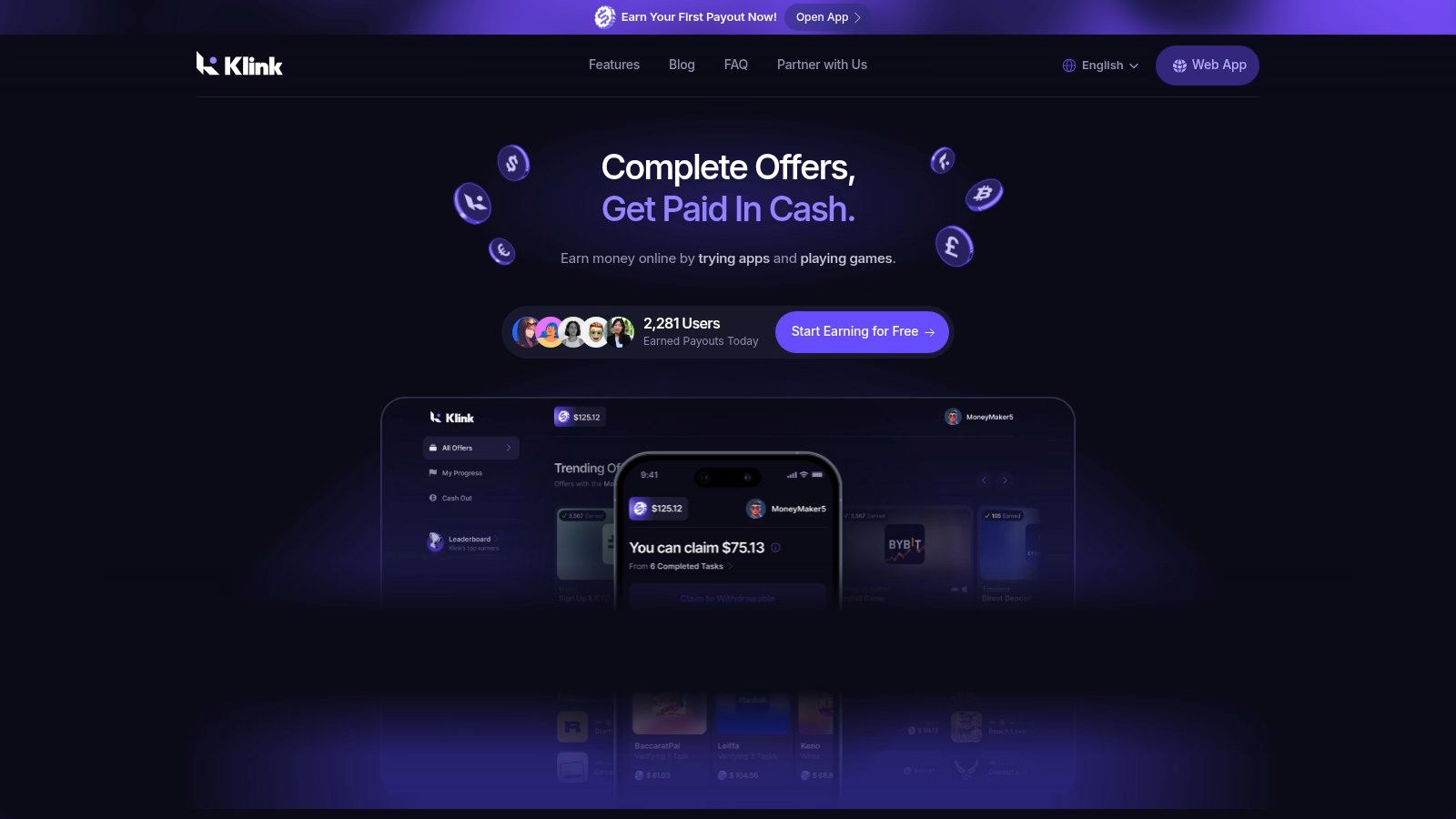
Want one app that lets you test several earning methods before you commit your time? Klink Finance is useful for that.
It combines app offers, games, surveys, and social tasks in one account. That setup solves a common beginner problem. New users often join a survey app, run out of surveys, and quit before they learn what proves most profitable for them. Klink gives you a few paths from the start on web, iOS, and Android.
Why Klink works for beginners
Variety matters more than hype in your first week. If one task type dries up, you can switch instead of abandoning the app.
Klink Finance is a free-to-join rewards platform that pays users through tasks like app trials, games, surveys, and social actions on the Klink Finance platform. It also supports users in many countries, which is a real advantage in a category where some apps are strong in the US and weak almost everywhere else.
The practical benefit is simple. You can test what fits your habits. Some users are fine with short surveys. Others do better with game milestones or app installs because the payout per completed task can be easier to judge.
First-hour tip: Try at least two task types before you decide whether the app is worth keeping. One weak survey does not tell you much.
Reality check before you sign up
Klink publicly says it has more than 30,000 registered users, has paid out over $134,000, and is available in 130+ countries. The platform also says casual users can earn over $100 per month and highly active users can make up to $1,000 per month, depending on task availability and engagement. Those figures come from Klink’s own site, so treat them as company-reported numbers, not a guarantee.
That trade-off matters. The app offers flexibility, but your results still depend on location, device compatibility, and whether the higher-paying offers are available when you check. Users who open it once in a while and tap random low-value tasks should expect small returns.
Here’s who it fits best:
Good fit: Users who want one dashboard for surveys, offers, games, and social tasks
Good fit: People outside the US who need broader country support
Less ideal: Users who want predictable hourly earnings
Less ideal: Anyone expecting fast, mostly passive income
My advice is to use Klink as a testing ground. In your first few sessions, compare survey completion time against game or app-offer payouts. That gives you a quick reality check and helps you decide whether Klink should be a main app or just a backup when other platforms are slow.
2. Swagbucks
Want one app that lets you test several earning methods without depositing money first? Swagbucks is usually one of the first names people see, and there is a practical reason for that. It combines surveys, cashback shopping, search rewards, games, and offer walls in one account.
That variety is the main selling point.
According to Passive App’s roundup of no-investment earning apps, Swagbucks has paid out more than $900 million to users worldwide since 2008. Treat that as a scale signal, not an income promise. A platform can have huge lifetime payouts and still deliver modest results for the average user.
Where Swagbucks fits
Swagbucks suits people who want options. If surveys dry up, you can switch to cashback, a game offer, or a short daily task. That makes it more forgiving than single-purpose survey apps, especially in your first week when you are still figuring out what your time is worth.
The trade-off is simple. More earning paths usually means more clutter, more low-value offers, and more temptation to spend 20 minutes chasing pennies.
A better approach is to test the app hard in your first hour.
First-hour setup tips
Do three things right away:
Complete your profile fully: Better profile data can reduce wasted survey attempts.
Check the highest-paying offers first: Compare the payout against the time requirement before you start.
Open the daily task or to-do area: Short repeatable tasks often give a better effort-to-reward ratio than random browsing.
If a survey starts with a long screening flow, exit and try another task type. If a game offer requires heavy playtime for a small reward, skip it. The goal on day one is not to do everything. It is to find one or two actions that pay reasonably for your location and device.
Reality check
Earlier source reporting on Swagbucks also describes weekly earnings as modest for casual users and notes that screening out of surveys is common. That matches how these GPT apps work in practice. Earnings depend heavily on country, age bracket, device type, and whether advertisers are actively buying traffic in your region.
Swagbucks also shares a parent company with InboxDollars. The same earlier source says InboxDollars has paid out over $80 million historically. That is useful background if you prefer cash-style rewards over points, but it does not change the core math. You still need to be selective.
Who should use it
Good fit: Users who want one app with several ways to earn
Good fit: Beginners who want to compare surveys, cashback, and offers in one place
Less ideal: Users who want stable hourly earnings
Less ideal: Anyone expecting fast cash from passive use
My advice is to judge Swagbucks by completed payouts, not by the number of available tasks. A big offer wall can look promising and still waste your time. If the app gives you one or two repeatable wins in the first few sessions, keep it. If not, move on.
3. Survey Junkie
Want a survey app that is easier to read and easier to use on day one? Survey Junkie is one of the cleaner options in this category.
It does one thing. Surveys. That narrower setup helps beginners who get lost in reward walls packed with games, cashback offers, and install tasks. You can usually see the point value up front, and the app is simpler to learn than many GPT platforms.
That simplicity has a trade-off. Your results depend heavily on profile matching. If advertisers are not buying your demographic, you will spend more time screening than earning.
Who should use Survey Junkie
Survey Junkie fits users who want a repeatable survey routine and do not care about variety. It is better for someone who wants to answer a few surveys during breaks than for someone trying to piece together the highest possible first-hour earnings across multiple task types.
The reality check matters here. Survey apps can feel productive without paying much. Earlier in this guide, Togwe’s earnings gap analysis noted that Swagbucks users commonly report low hourly earnings and frequent survey disqualifications. Survey Junkie is cleaner than Swagbucks, but it does not escape the same core problem. You still need enough completed surveys, not just enough available surveys.
How to make your first hour count
New users often waste time by tapping the longest or highest-looking survey first. A better method is to test the app quickly and protect your time.
Fill out your profile before chasing surveys: This improves matching and cuts some avoidable disqualifications.
Start with short surveys: They show you how often you screen out without burning 20 minutes at a time.
Watch your completion pattern: If you get screened out several times in a row, stop and come back later instead of forcing it.
Cash out once you hit a useful threshold: Small confirmed payouts matter more than a large unfinished balance.
Survey Junkie supports PayPal, gift cards, and in some cases bank transfer options. That flexibility helps if you care about getting cash instead of being stuck with one reward type.
My practical take is simple. Survey Junkie is a good test app for people who want a focused survey experience and a low-friction setup. It is not a high-earning app for most users. If your first few sessions produce steady completions, keep it in your rotation. If they do not, move on fast.
4. Prolific
Prolific is where many experienced earners go when they’re tired of low-quality survey apps. Instead of acting like a generic reward wall, it focuses on research studies from universities, researchers, and product teams.
The big practical difference is visibility. You usually see the expected time and pay before joining a study. That helps you judge whether a task is worth doing before you commit.
Why Prolific feels better than standard survey apps
With many survey panels, you answer several questions before learning you’re not a fit. Prolific tends to feel fairer because the studies are more structured and the expectations are clearer. For people who care about time efficiency, that alone is enough to make it a better experience.
It’s also one of the few platforms in this category that many users treat like a quality filter, not just an income source. If a study is available and you qualify, it’s often worth prioritizing over generic surveys elsewhere.
If Prolific has an open study and you’re eligible, do that first. Then use lower-tier apps only as filler.
The real limitation
Prolific’s problem isn’t quality. It’s volume.
You may not see a constant flow of studies every day, and the best ones can fill quickly. That means Prolific works best as part of a mix, not as your only no-investment earning app. Keep notifications on, check regularly, and be ready to respond fast when a good study appears.
A few practical tips help:
Turn on alerts: Good studies don’t sit around long.
Read instructions carefully: Research tasks often reward accuracy and compliance.
Stay honest in demographic details: Consistency matters on participant platforms.
Prolific is one of the strongest options if you want a better experience than mass-market survey apps. It’s not ideal for people who want constant task flow, but it is ideal for people who care about quality, fairness, and clear time expectations.
5. UserTesting
UserTesting pays people to test websites, apps, and digital experiences while speaking their thoughts out loud. That sounds simple, but it’s a different skill from tapping survey answers.
If you’re observant, clear when speaking, and comfortable giving quick reactions, UserTesting can feel far more engaging than standard earning apps. You’re not pretending to enjoy endless questionnaires. You’re reacting to real designs, broken flows, confusing buttons, and signup forms that make no sense.
Why some people do better here
The strongest part of UserTesting is that tests show pay before you accept, and the tasks themselves are more concrete. You might try a checkout process, explore an app, or compare product pages. For many users, that’s more mentally tolerable than survey churn.
It also tends to cut down on one specific frustration. Instead of broad random surveys, the platform uses screening to match contributors to relevant tests. You still won’t qualify for everything, but the process often feels more purposeful.
What can go wrong
UserTesting isn’t passive. You need a quiet environment, a decent microphone, clear speech, and the ability to explain what you’re thinking in real time. If you mumble, rush, or go silent, you’ll struggle.
A lot of new users fail because they treat it like a form-filling job. It’s not. Clients want natural spoken feedback.
Speak continuously: Say what confuses you, what you expect, and what you’d click next.
Use a clean setup: Background noise can ruin an otherwise good test.
Take the practice seriously: Your early performance affects whether this becomes worth your time.
UserTesting is best for people who want fewer but more engaging tasks. If you dislike talking or don’t have a quiet space, skip it. If you can communicate clearly, it can be one of the better ways to earn without any upfront cost.
6. Amazon Mechanical Turk MTurk
MTurk is one of the oldest marketplaces for online microtasks. Instead of a polished rewards app feel, it works more like a task exchange. Businesses and researchers post HITs, and workers pick from what’s available.
That structure gives you flexibility, but it also creates a quality problem. Some tasks are worth doing. Many aren’t.
Who MTurk is really for
MTurk suits people who don’t mind learning a system. If you’re willing to sort requesters, build qualifications, and develop a routine, it can become a useful flexible earning source. If you want instant simplicity, it probably won’t.
That’s the trade-off with marketplaces. Freedom is good, but only if you can filter well.
How to avoid wasting time on MTurk
A beginner mistake is grabbing whatever appears first. On MTurk, that’s a fast way to burn time on low-paying tasks. You need to be selective.
Check requester quality: Approval behavior matters.
Build qualifications early: Better access can improve your task pool over time.
Protect your approval rate: Rejections can limit your future options.
MTurk has scale, and there are always tasks moving through the system. But scale alone doesn’t make it beginner-friendly. The platform rewards patience, pattern recognition, and discipline more than excitement.
For the right person, that’s fine. For someone who wants a clean mobile-first side hustle, there are easier apps on this list.
7. Microsoft Rewards
Microsoft Rewards is one of the simplest no-spend options because it turns normal online behavior into points. If you already use Bing or other Microsoft services, the setup feels natural. You earn through searches, quizzes, and certain account activities, then redeem points for gift cards or similar rewards.
This app category doesn’t usually feel exciting. That’s okay. Sometimes boring works.
Where Microsoft Rewards fits
Microsoft Rewards is best for light-effort earning. It won’t replace a stronger app-testing or survey routine, but it can add a small steady layer with very little friction. You’re not carving out a serious work session. You’re building a habit.
That makes it especially useful for people who give up on heavier apps after a week. Search-based routines are easier to maintain than long survey sessions.
What to keep in mind
The main compromise is payout format. This is a points program, not a direct cash app, and reward options can vary by region. You also need to stay active because points expire after inactivity.
That sounds minor, but it changes how you should use it.
Use it as a background earner: Treat it like a small daily add-on.
Redeem before inactivity becomes a problem: Don’t let points sit untouched.
Pair it with one stronger app: Microsoft Rewards works better as a supplement than a main strategy.
If your goal is pure cash, this won’t be your top pick. If your goal is low-effort consistency, it belongs on the shortlist.
8. Google Opinion Rewards
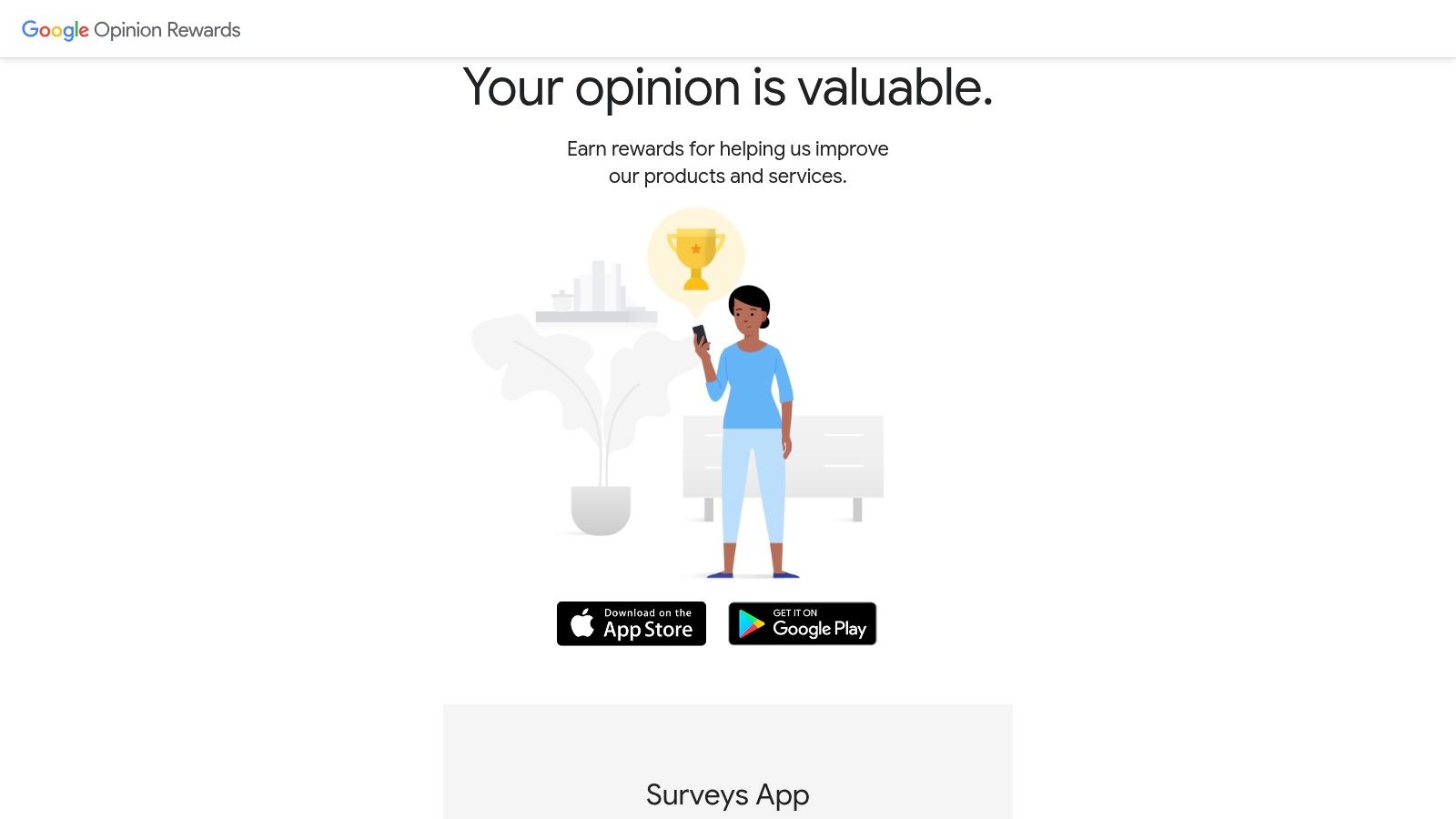
Google Opinion Rewards is one of the fastest apps on this list in terms of effort per task. Surveys are short, usually notification-based, and easy to complete in spare moments. That’s the appeal. You’re not committing to long sessions.
For many people, this is the cleanest “why not?” app to install.
Why it works despite limited volume
Google Opinion Rewards isn’t built for big earnings. It’s built for convenience. You answer a quick question, get a small reward, and move on.
That’s why it works best when you stop expecting it to be a side hustle by itself. It’s a micro-earner.
Keep this app installed even if you use stronger platforms. It takes so little effort that the opportunity cost is low.
The trade-off
Survey frequency isn’t guaranteed, and payout format depends on your platform and region. Android users often receive Play credit, while some iOS users can get PayPal cash in supported markets. So the app is useful, but not equally useful for everyone.
A few habits help:
Enable notifications: Missed surveys can mean missed earnings.
Answer accurately: Consistency matters with profile-based survey apps.
Treat it as bonus money: It’s a nice extra, not a core income stream.
Google Opinion Rewards is best for people who want the least possible friction. Install it, respond when prompted, and let it run unobtrusively in the background of your broader app mix.
9. Freecash
Want higher upside than tiny survey payouts, without putting money in first? Freecash is one of the clearer options, but only if you treat it like task work, not passive income.
Freecash puts game offers, surveys, app installs, and signup tasks in one dashboard. The main advantage is transparency. You can usually see the reward before you start, which makes it easier to decide whether a task is worth your time. That matters in your first hour. New users often waste it on low-value surveys instead of a simple, well-tracked offer.
Where Freecash stands out
The earning range can be wider here than on survey-first apps. According to The Penny Hoarder’s Freecash overview, users report average daily earnings of $17.53 from game offers alone. The same source says dedicated participants may reach $1,000 monthly, game offers can pay $1 to $100+ per milestone, and daily results often land around $10 to $30 depending on completion rates.
That sounds good. The trade-off is effort and precision.
Freecash works best for users who read instructions carefully, track deadlines, and avoid random clicking. A high-paying offer can be worth it. A poorly chosen one can waste an evening.
Reality check before you sign up
This app rewards selectivity more than volume. Some offers pay well because they take real time. Others look attractive until you notice the milestone window, the level requirement, or the payout hold.
Start simple. In the first session, pick one offer with clear steps and a modest reward. Finish it cleanly. Confirm it tracks. Then scale up.
A few habits make a real difference:
Choose easy-to-verify offers first: App installs, free trials, or beginner game milestones are better than complex multi-day grinds.
Read every condition before starting: Missed steps are a common reason people lose credit.
Keep screenshots of progress: This helps if tracking fails and you need support.
Check payout method and hold time early: Fast earnings are less useful if withdrawal terms do not fit your goal.
Freecash is a good fit for people who want a stronger earning ceiling than apps like Google Opinion Rewards, and who do not mind managing offers carefully. If your goal is quick, low-friction tasks, other apps are easier. If your goal is to squeeze more from your spare time, Freecash deserves a spot on the shortlist.
10. Mistplay
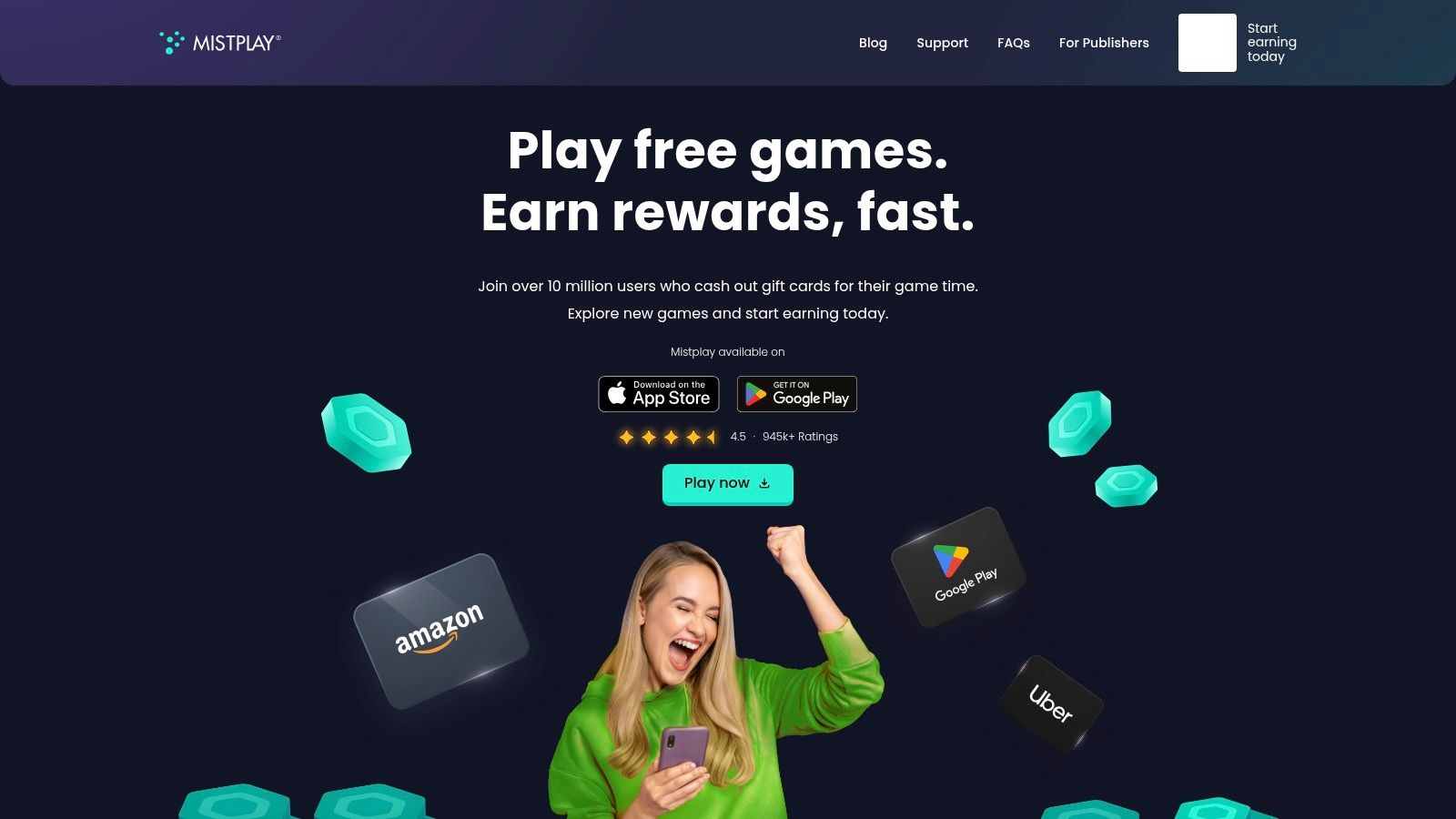
Mistplay is built for one type of user. The mobile gamer who was going to play anyway.
If that’s you, Mistplay makes sense. If it’s not, skip it.
The app rewards Android users for discovering and playing featured games through its own system, then lets them redeem points for gift cards. That means it’s not a direct cash app, but it can still be useful if you already spend free time in games and don’t mind converting that time into rewards.
When Mistplay is worth it
Mistplay works best when the earning activity matches your existing behavior. That’s the key test for any no-investment app. If you have to force yourself to use it, it won’t last.
With Mistplay, the loop is simple. Install featured games, play through the launcher, level up, and build rewards over time. It’s easy to understand, which is one reason gamers keep it installed longer than more demanding GPT apps.
Where it falls short
The downside is obvious. It’s Android-only and focused on gift cards. If you want direct cash, or if you use iPhone, this won’t be your best option.
There’s also a second issue people miss. Not every game stays fun long enough to feel worth grinding for rewards.
Choose games you might enjoy: Don’t chase every promoted title.
Check reward progress often: Some games feel slow after the early stages.
Use it for spare-time gaming only: Mistplay is better as a bonus than as a main earner.
Mistplay is a good fit for gamers who want low-pressure rewards without surveys. It’s not a broad side-hustle platform, and it doesn’t pretend to be. That clarity is part of its appeal.
Top 10 No-Investment Money-Earning Apps Comparison
Platform | Core Earning Types | Payouts & Withdrawal Options | User Experience & Trust | Best For / Unique Selling Point |
|---|---|---|---|---|
Klink Finance | App installs, games, surveys, social quests, partner offers | Fiat (USD, EUR, GBP +20+), BTC/ETH/SOL, fast/instant withdrawals | Real-time tracking, promotions & leaderboards, 30k+ users, $134k+ paid, active communities | Mobile-first side-hustles; revenue-share model with brands, Recommended |
Swagbucks (Prodege) | Surveys, offer walls, cashback, search, games | PayPal cash, large gift-card catalog | Long-standing brand, frequent promos, broad catalog | Stack multiple small earners; flexible redemptions |
Survey Junkie | Survey-first panel, points system, optional passive surf | PayPal, U.S. bank transfer, gift cards; low min cashout (~$5) | Clear point-to-dollar, consistent U.S. support | Transparent surveys and low cashout threshold |
Prolific (Participants) | Academic and product studies | PayPal (commonly) | Pay/time shown upfront, fair policies, higher average rates | Better-paid research studies; clear compensation estimates |
UserTesting (Contributor Network) | Unmoderated & live UX tests, spoken feedback | Pay stated per test, typically PayPal | Engaging tasks, higher per-hour potential, targeted screening | Higher payouts for usability testing and richer tasks |
Amazon Mechanical Turk (MTurk) | Microtasks (data labeling, checks, short surveys) | Bank transfer or Amazon gift card (US) | Massive task inflow, variable requester quality | Flexible, large marketplace for incremental earnings |
Microsoft Rewards | Searches, quizzes, Microsoft Store activity | Points → gift cards or donations (no direct cash) | Reliable first-party program, no-spend earning | Easy daily searches/quizzes for point rewards |
Google Opinion Rewards | Ultra-short, notification-triggered micro-surveys | Android: Play credit (commonly); iOS (US): PayPal | Very quick surveys, irregular frequency | Fast micro-earnings with minimal time per survey |
Freecash | GPT tasks, surveys, app trials, offer walls | PayPal, crypto (BTC/etc.), Visa, gift cards | Visible reward amounts, frequent promos, fast payouts | Broad withdrawal options including crypto |
Mistplay (Android) | Discover & play featured mobile games, level up | Gift cards only | Simple play-to-earn loop, steady trickle of units | Gamers on Android who want gift-card rewards |
Your Next Step Start Earning, One Task at a Time
The best money earning apps no investment are not all trying to do the same job. That’s the first thing to understand before you install anything. Some apps are broad platforms. Some are survey tools. Some are game-based. Some are better for short bursts of attention, while others only make sense if you can stay focused and consistent.
That’s why many users waste time at the start. They download too many apps, chase every shiny offer, then burn out before they learn what suits them.
A better approach is simple. Pick one main app and one backup app.
Your main app should match the way you already spend time. If you like trying apps, game offers, and surveys in one place, Klink Finance makes sense. If you want a long-running all-rounder, Swagbucks is still useful. If you only want surveys, Survey Junkie is easier to follow. If you value higher-quality studies and don’t mind limited volume, Prolific is a smarter pick.
Your backup app should fill the gaps. Microsoft Rewards or Google Opinion Rewards work well for low-effort background earning. UserTesting is good if you can speak clearly and want more engaging work. Mistplay makes sense if gaming is already part of your routine.
That’s the practical way to build momentum. Don’t ask, “Which app pays the most?” Ask, “Which app will I still use next week?”
Reality check: A decent no-investment app is only useful if it fits your habits, your location, and your patience level.
Location matters more than many guides admit. Some offers are stronger in the United States, while others have more limited task inventory elsewhere. Survey matching also depends on demographics. A platform that works well for one person may feel dead for another. That doesn’t always mean the app is fake. It often just means you’re not the ideal user profile for that offer mix.
You should also expect some trial and error in the first few days. That’s normal. The goal isn’t to win immediately. The goal is to build a small routine around spare time you’d otherwise waste. Waiting rooms, lunch breaks, evenings on the couch, and commute downtime are where these apps make the most sense.
A few rules will save you from the usual beginner mistakes:
Start small: Test one or two apps first instead of opening accounts everywhere.
Protect your time: Skip long low-value tasks if the payoff isn’t clear.
Track what works: If one app consistently gives you better offers, lean into it.
Cash out when reasonable: Small redemptions help confirm the platform works and keep motivation up.
Don’t confuse no investment with no effort: You’re trading time and attention for rewards.
Klink Finance fits well into this strategy because it gives beginners several earning paths in one place without forcing them into one narrow model. That matters if you’re still figuring out whether surveys, game offers, or app trials are your best lane.
In the end, the best app is the one you open, understand, and stick with. Consistency beats curiosity here. Small earnings won’t look impressive on day one, but they do add up when you stop chasing hype and start using the right tools properly.
If you want extra income without spending money upfront, that path is real. Keep your expectations realistic, choose carefully, and let routine do the work.
If you want a simple place to start, Klink Finance is worth trying. It brings surveys, games, app offers, and social quests into one platform, supports users worldwide, and gives you flexible payout options without any upfront cost.

High Quality Offers,
Real Payouts
Start Earning with Klink Now!







Share Article
Related Articles
Read more, Earn more