
Chances are, the reason your favorite mobile game or news app is free is because of in-app advertising. It's a lot like TV commercials—brands pay developers to show you ads, which means you get to enjoy the content without paying a subscription.
What Is In-App Advertising and Why It Matters
If you’ve ever watched a short video to unlock a bonus level or noticed a small banner ad at the bottom of an app, you’ve seen in-app advertising in action. It’s the engine that quietly powers a massive slice of the mobile economy through a simple but powerful value exchange.
The whole system is built on a win-win-win setup. First, you get free access to millions of apps, from social media and productivity tools to games and entertainment. Second, developers earn a steady revenue stream that lets them maintain, update, and improve what they’ve built. And finally, advertisers get a direct line to a highly engaged audience that’s actively using their devices.
The Foundation of the Mobile Economy
The scale of this ecosystem is staggering. The global in-app advertising market is growing at a wild pace, with spending projected to hit $390.04 billion in 2025 alone. That number is expected to climb to an almost unbelievable $533.92 billion by 2029, proving just how essential mobile apps have become in our daily lives.
In the United States, in-app ad revenue is on track to reach $147.52 billion in 2025, which accounts for over 82% of all mobile ad spending. This explosive growth is fueled by massive smartphone ownership—over 85% in the U.S.—and increasingly sophisticated advertising tech. You can dig deeper into these app monetization statistics on AdPushup.com.
At its core, in-app advertising is about turning attention into opportunity. It transforms the time people spend on their phones into a sustainable business model for creators and a powerful communication channel for brands.
This model is more than just a way for developers to cash in; it fuels innovation for developers, gives brands a captive audience, and grants users access to a world of free content.
A New Way to Participate
But what if you, the user, could get a direct piece of that advertising revenue? This is where the model is starting to evolve. New platforms are emerging that let you do more than just view ads—they let you actively participate and earn from them.
This is the whole idea behind Klink Finance, a global rewards platform that connects you directly with brands looking for real engagement. Instead of just passively watching an ad, you can complete tasks like trying a new game or answering a survey and actually get paid for your time.
Klink Finance gives you a direct share of the advertising money that brands are already spending, turning your screen time into a genuine earning opportunity.
Exploring The Most Common Ad Formats
Just like TV commercials come in different flavors—from quick 30-second spots to longer sponsored segments—in-app ads use various formats to get the message across. Each one is built for a specific purpose, trying to strike that delicate balance between what the advertiser wants and what the user will tolerate.
Think of these ad formats as tools in a developer's toolkit. Some are designed to grab your attention immediately, while others are meant to blend right in. The choice of format can completely change how an app feels and, more importantly, how much money it can make.
This simple diagram shows how the key players—advertisers, developers, and users—all fit together.
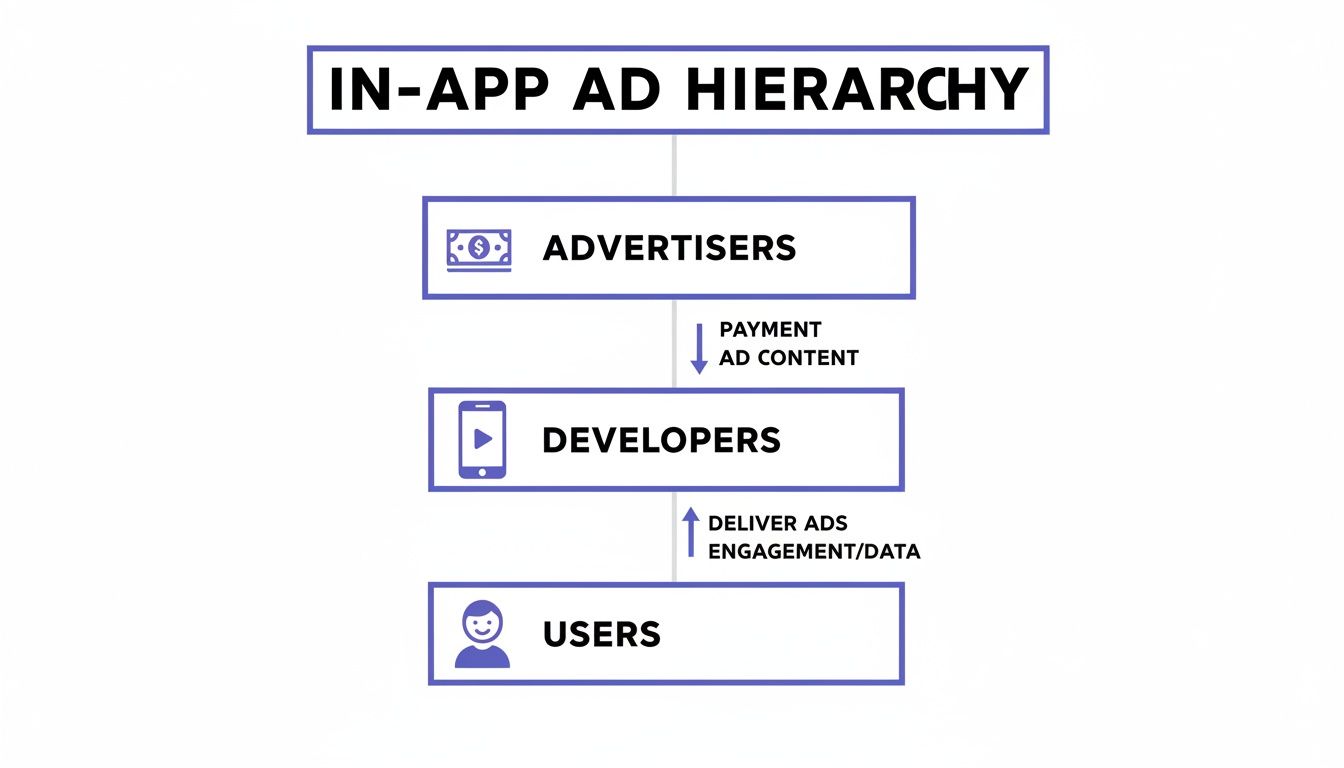
Advertisers provide the money, developers integrate the ads into their apps, and users interact with them. It’s a cycle that keeps the whole system running.
Banner Ads: The Digital Billboards
Banner ads are the old guard of digital advertising. You know them well—they're the small strips or "banners" that usually stick to the top or bottom of your screen. They just hang out there while you scroll, which is why they’re a go-to for apps like news readers or simple utilities where interrupting the user is a bad idea.
Don't let their subtlety fool you; their impact is enormous. Banner ads grabbed a massive 34.6% share of the in-app advertising market in 2023, a market valued at over $221.22 billion. That number is expected to hit a staggering $600.7 billion by 2033, all thanks to smarter ad tech and the explosion of smartphone use.
Interstitial Ads: The Full-Screen Interruption
You’ve definitely run into these. Interstitial ads are the full-screen pop-ups that show up at natural breaks in an app—like between levels in a game, after you finish a task, or while a new page is loading. They demand your full attention, which makes them incredibly effective for big brand messages or driving app installs.
Of course, they're a lot more intrusive than a simple banner. Developers have to be careful with them. Timed correctly, they’re just a momentary pause. Timed poorly, they’re an annoying roadblock that makes you want to close the app for good.
Rewarded Video: The Value Exchange
This format has become a massive hit, especially in mobile gaming. Rewarded video ads offer a straightforward deal: watch this short video, and you'll get something cool in return. It could be extra lives, in-game currency, or access to a premium feature.
It's a genuine win-win-win situation:
Users get perks without opening their wallets.
Developers make money from users who would otherwise never pay.
Advertisers get a fully engaged audience that actually chose to watch their ad.
This concept of a value exchange is the bedrock of platforms like Klink Finance. Klink Finance is a global rewards platform where users can earn money for completing offers like trying new apps and filling out surveys. It turns user engagement into a direct financial benefit.
Native Ads: The Chameleons
Last but not least, we have native ads. These are the chameleons of the ad world, designed to blend in perfectly with the app's content. A promoted post in your social media feed, a sponsored product listing on an e-commerce site—those are native ads.
Because they don't scream "I'm an ad!" they feel less disruptive and more like a helpful recommendation. This format is all about respecting the user's experience while still delivering a powerful, context-aware message for the advertiser. To get the most out of these, it helps to understand different mobile app marketing strategies.
To make it easier to see how these formats stack up, here’s a quick comparison.
Comparison of In App Ad Formats
Ad Format | User Experience | Typical Engagement | Best For |
|---|---|---|---|
Banner | Low-impact, constant presence | Passive, low-to-moderate clicks | Brand awareness, persistent messaging |
Interstitial | High-impact, full-screen | High, but can be intrusive | Driving installs, big announcements |
Rewarded Video | Opt-in, value-based | Very high (user-initiated) | Monetizing non-paying users, engagement |
Native | Seamless, non-disruptive | High, feels like organic content | Content promotion, e-commerce listings |
Choosing the right format really depends on the app's function and the developer's goals. A news app might stick to banners and native ads, while a hyper-casual game will likely lean heavily on interstitials and rewarded videos.
How App Monetization Models Actually Work
Ever wonder how a simple ad click or a video view actually puts money in a developer's pocket? It’s not magic—it's a system built on a few core payment models. These are the financial blueprints that dictate how advertisers pay for results when it comes to in app advertisement.
Think of it like hiring a contractor. You could pay them by the hour, per completed job, or maybe offer a bonus for finishing ahead of schedule. Advertisers do something similar, picking a model that matches what they want to achieve, whether that's just getting their name out there or driving actual sales.
Getting a grip on these models is the key to understanding how the whole system works. Each acronym you see is just a different way of measuring value and how it’s exchanged between an advertiser and an app publisher.
Decoding the Core Monetization Models
Most of the ad world runs on three big models: CPM, CPI, and CPA. Each one zeroes in on a different user action, and advertisers choose the one that gives them the most bang for their buck.
CPM (Cost Per Mille): "Mille" is just Latin for a thousand. So, Cost Per Thousand Impressions is exactly what it sounds like. An advertiser pays a set price every time their ad is shown 1,000 times. This is perfect for big brands focused on visibility—it’s the digital equivalent of putting up a billboard on a busy highway. The goal isn't an immediate click; it's widespread brand recognition.
CPI (Cost Per Install): This one goes a step further. Advertisers only pay when someone not only clicks their ad but actually installs the app. It's a performance-first model, which is why app developers trying to grow their user base love it. For them, a simple view isn't enough—they need you to hit that download button.
CPA (Cost Per Action): This is the most targeted of the three. Here, an advertiser pays only when a user completes a specific action after installing the app. That action could be anything from signing up for a free trial, buying something in the app, or hitting level 10 in a game. CPA is all about finding high-value users who are more likely to stick around.
To make sure your ads are generating real revenue, it helps to understand various effective mobile app monetization strategies.
Think of these models as a ladder of value. CPM pays for eyeballs, CPI pays for new users, and CPA pays for engaged customers. The more effort required from the user, the higher the payout for the publisher.
This whole system ensures advertisers only pay for the outcomes that matter to their business, which is what makes in-app advertising such an efficient way to market.
The Rise of Rewarded Monetization
While CPM, CPI, and CPA are the bedrock of the industry, a much smarter approach has taken hold: rewarded monetization. This model flips the script by cutting the user in on the deal, directly compensating them for their time and attention.
Instead of just passively showing ads, rewarded platforms create a marketplace built around user actions. Brands pay for specific results—like playing a game to level 5, trying a new shopping app, or filling out a survey—and a big chunk of that payment goes straight to the user who did the work.
This creates a transparent and powerful win-win-win. It’s exactly how Klink Finance operates. Klink Finance is a global rewards platform where users can earn money for completing offers from our brand partners. You can see how we help both developers and advertisers find dedicated users through our rewarded monetization programs.
This model is a game-changer because it lines up everyone's interests perfectly:
Advertisers get highly motivated users who have already agreed to engage with their app.
App Publishers (and platforms like Klink) generate revenue by making these high-value connections happen.
Users get to turn their screen time into actual, tangible rewards, finally getting their piece of the advertising pie.
By focusing on clear, action-based goals, rewarded monetization transforms passive ad-watching into an active and mutually beneficial partnership. It's the natural evolution of performance marketing, built for a world where the user comes first.
Measuring Success With Key Performance Indicators
In the world of in app advertisement, launching a campaign without tracking data is like driving blindfolded. You might be moving, but you have no idea if you’re headed in the right direction. Success isn't about guesswork; it's about data.
This is where Key Performance Indicators (KPIs) come in. Advertisers and developers rely on these specific metrics to see what’s working, what isn't, and how to make things better.
Think of KPIs as the vital signs of an ad campaign. They tell the story of user engagement, revenue, and the overall health of an app. By keeping a close eye on these numbers, developers can fine-tune their monetization strategy, and advertisers can make sure every dollar of their budget is spent reaching the right people with the right message.
Core Metrics That Drive Decisions
To really get how the in-app economy works, you need to speak the language of its core metrics. While you can track dozens of data points, a few stand out as absolutely essential for measuring what matters.
eCPM (Effective Cost Per Mille): This one calculates the total ad revenue you generate for every 1,000 ad impressions you serve. You can think of it as your app’s "earning power." A high eCPM means your ad space is valuable and advertisers are willing to pay a premium to get in front of your users.
ARPDAU (Average Revenue Per Daily Active User): This metric breaks down how much money, on average, each active user generates per day. Imagine a coffee shop owner calculating the average spend of every customer who walked in today—that's ARPDAU. It’s a critical health check that shows how well you're monetizing your daily audience.
LTV (Lifetime Value): This is the ultimate long-term metric. It predicts the total revenue a single user will generate over their entire time using your app. LTV is crucial because it helps you figure out which user acquisition channels bring in the most valuable, long-term customers, not just one-time installers.
To really dig into this, it's worth learning more about measuring marketing campaign effectiveness with comprehensive methods.
The Big Picture of Mobile Ad Spend
Understanding these KPIs is more important than ever when you look at the sheer scale of the market. In Q1 2025 alone, U.S. digital ad spend hit a staggering $31 billion, which was a 12% jump year-over-year, driven by a record 3.9 trillion impressions.
Globally, the numbers are even bigger. Mobile ad spending reached about $402 billion in 2024 and is on track to hit $1.3 trillion by 2030, with in-app ads leading the charge. These figures make it crystal clear: apps are the prime real estate for advertisers today.
By tracking metrics like ARPDAU and LTV, advertisers and developers can move beyond simple clicks and installs. They gain a deep understanding of user behavior and campaign profitability, allowing for smarter, data-driven decisions that fuel sustainable growth.
Why Measurable Results Matter
These metrics are exactly why advertisers are increasingly partnering with platforms that deliver tangible, measurable results.
In a performance-based model, like the one used by Klink Finance, the focus shifts from vague impressions to concrete actions. Klink Finance is a global rewards platform where users earn money by completing offers from our brand partners.
Advertisers on Klink Finance don't pay for just showing an ad; they pay when a user completes a high-value action, like reaching a certain level in a game or finishing a detailed survey. This approach gives advertisers a crystal-clear return on investment (ROI) because every dollar spent is tied directly to a measurable KPI.
For users, it means their engagement has real value. For advertisers, it means they’re acquiring genuinely interested and active users. You can find more on this in our latest market insights on the Klink Finance blog.
Klink Finance: Turning Ads Into Earnings
Let's be honest: the usual model for in-app advertisement is a one-way street. Developers and advertisers make money from your attention, but you're just along for the ride. It's the system that keeps most apps free, but it completely misses the chance for a more engaging setup where everyone gets a piece of the pie.
What if you could actually step into that advertising loop and get paid for taking part? That’s the entire idea behind Klink Finance. Klink Finance is a global rewards platform built to put you—the user—right at the center of the mobile economy, connecting brands that want real engagement with people who want to earn from their screen time.
Instead of just showing you random ads, Klink Finance partners with top-tier brands that need users to perform specific, valuable actions. This could be anything from playing a new mobile game up to a certain level, trying out a new shopping app, or filling out a market research survey.
How Klink Flips Advertising on Its Head
The Klink Finance model is refreshingly simple. Brands pay for results they can actually measure—like a new user signing up or a specific task getting done—and Klink Finance passes a big chunk of that payment directly to the user who did the work. You’re no longer just watching; you're an active partner.
This approach is a game-changer for online earners, students, and gig workers who need flexibility and control over their income. Klink Finance is built from the ground up to give them exactly what they need.
Instant Cash-Outs: Forget waiting weeks for a payout. Klink Finance lets you withdraw your earnings fast, so the money you earn is in your hands almost immediately.
A Simple Dashboard: No confusing menus or cluttered interfaces. The platform is clean and straightforward, letting you track your tasks, see your earnings, and manage rewards in real-time.
A Wide Variety of Opportunities: From gaming and app testing to surveys and social media tasks, there’s a steady flow of new ways to earn. You’ll always find something that fits.
By connecting you with these opportunities, Klink Finance turns your spare time online into a genuine side hustle. If you want to dive deeper into how it all works, check out our complete guide on what Klink is and how to start earning money online.
Klink Finance reinvents rewarded engagement by shifting the power from passive ad viewing to active participation. It gives users a direct stake in the digital economy, making sure their time and attention are actually valued and compensated.
This creates a much more balanced and respectful system. Brands hit their marketing goals by connecting with genuinely motivated users, and those users get a reliable way to make money from things they might be doing anyway. It’s really the next logical step for in-app advertisement—one where value is shared, not just taken. With Klink Finance, you finally get your piece of the advertising pie.
Juggling Privacy and Performance: The New Rules of Advertising
In today's world of in-app ads, performance and privacy aren't just related—they're completely intertwined. The old model of just blasting ads at people is dead. Modern advertising runs on trust, which means respecting user consent isn't just a box to tick for legal reasons; it’s how you build a real audience.
At the same time, no advertiser is just throwing ads out there and hoping for the best. The goal is to constantly get smarter. By digging into performance data and testing what works, they can fine-tune campaigns to deliver ads that actually feel relevant and engaging. This isn't about interrupting people anymore; it's about creating interactions they actually value.
Why User Consent is Everything
People are smarter and more protective of their digital privacy than ever. The rules from app stores and regulators are catching up, giving users real control over their data. For advertisers, this flips the script: earning someone's trust with clear, upfront consent is now step one.
This is where platforms built on an opt-in model have a massive upper hand. When someone actively chooses to engage with an ad or complete an offer, they’re telling you they’re interested. That's a far cry from a forced ad view. It results in a higher-quality lead for the advertiser and a much better experience for the user.
When engagement is voluntary, advertising stops being an interruption and becomes an opportunity. This transparent approach doesn't just respect privacy—it delivers results that are far more meaningful and easier to measure.
Using A/B Testing to Stop Guessing and Start Winning
Once you have that consent, the real work begins: optimization. Smart advertisers use data to make systematic improvements, and one of the most powerful tools for this is A/B testing, sometimes called split testing.
It’s a simple concept. Let's say a developer wants to promote a new mobile game. They could create two completely different video ads:
Ad A: Pure action. It’s all fast-paced, explosive gameplay.
Ad B: Story-driven. It focuses on the game’s unique characters and plot.
They then show Ad A to half their audience and Ad B to the other half. By tracking simple metrics like click-through rates and, more importantly, installs, they get a clear, data-backed answer on which message truly connects. This eliminates guesswork and ensures the ad budget is spent on creative that actually drives results.
This is exactly where a platform like Klink Finance brings something unique to the table. On Klink Finance, every single interaction is opt-in. Users browse and choose the offers they want to complete, which creates a totally transparent and consent-first environment. For brands, this means you're not just reaching an audience—you're connecting with motivated people who have already raised their hands to participate. It’s a model that respects privacy while delivering concrete, high-quality outcomes.
In-App Advertising: Your Questions Answered
Even after getting the big picture, you probably still have a few questions. Let's tackle some of the most common ones that come up when people start exploring in-app ads and rewarded platforms.
How Is In-App Advertising Different From Web Advertising?
The biggest difference comes down to the environment. In-app ads live inside a mobile app—a controlled, self-contained world. This allows for far more immersive and interactive ad formats, like rewarded videos, that just don't work as well on a mobile website.
Mobile web ads, on the other hand, show up on websites you visit through a browser. They’re great for casting a wide net, but they often can't match the deep targeting or the focused attention you get inside an app. Advertisers know that when someone is using an app, they're generally more engaged, making the ad feel like a natural part of the experience.
How Do Platforms Like Klink Finance Make Money?
Klink Finance is a global rewards platform where users can earn money for completing offers. Our platform runs on a performance-based model, which is good for everyone involved. It’s pretty straightforward: brands pay Klink Finance only when a specific, measurable action happens, like a user installing their new game or finishing a market research survey.
Klink Finance then passes the majority of that payment directly to the user who did the work. The platform just keeps a small slice for connecting the two. This setup means brands only pay for real results, and users get paid fairly for their attention and time. It’s a transparent cycle where everyone wins.
Is It Safe to Complete Offers on Rewarded Platforms?
Yes, as long as you stick with a reputable platform. User safety is a huge deal for legitimate platforms, and they put in the work to protect their community.
The real key to a safe experience is a platform's commitment to vetting its partners. When a platform only works with well-known and trusted brands, the risk of shady offers practically disappears, creating a secure space for users to earn.
For example, Klink Finance is a global rewards platform that only partners with established, verified brands to make sure every offer is legitimate and clear. We give you simple instructions for every task and ensure payouts are reliable. This focus on security lets our users complete offers with confidence, knowing they’re in a safe and rewarding ecosystem.
Ready to turn your screen time into earnings? With Klink Finance, you can get paid for trying new apps, playing games, and completing simple tasks. Start earning today.


High Quality Offers,
Real Payouts
Start Earning with Klink Now!







Share Article
Related Articles
Read more, Earn more