
Somewhere between your morning commute, your lunch break, and that stretch of time before bed, you’ve probably seen an ad promising easy money for trying apps, playing games, or answering a few questions.
That can sound fake. Sometimes it is.
But paid to complete offers online is also a real part of the side-hustle world when you understand how it works, why companies pay for it, and what separates a normal offer from a trap. The important part is not just finding a platform. It is knowing the business model well enough to judge any offer you see.
If you learn that part first, you stop guessing. You start filtering.
Can You Really Get Paid to Complete Offers Online?
You are on the bus home, scrolling through your phone, and you see an offer that says you can earn a few dollars for trying a game or signing up for an app. Your first question is usually the right one. Why would anyone pay for that?
The short answer is yes, you really can get paid to complete offers online. The catch is that this only makes sense once you understand the business behind it.
Paid offers are small tasks tied to a company goal. That goal might be getting a new app install, collecting survey responses, testing a signup flow, or bringing in new users for a game. A platform tracks whether you completed the required action and sends you a reward if the action qualifies.

The easiest way to frame it is this. You are getting a small share of a marketing budget.
That matters because it helps you judge what is real. A legitimate offer has a business reason behind it. A sketchy one usually relies on hype, vague promises, or confusing requirements because there is no clear value being exchanged.
What beginners often misunderstand
Many beginners hear “paid online offers” and assume the income works like a job with steady hours and steady pay. It usually works more like picking up loose change for completing specific errands. Some errands take two minutes. Some take a week of follow-through. The pay changes with the difficulty, the advertiser, your country, and whether you meet the offer requirements.
So the better expectation is simple:
This is usually extra income: Paid offers can help with small bills, gift cards, or savings goals, but they rarely replace a main paycheck.
Short tasks tend to pay less: Surveys, app installs, and email signups are quick because the advertiser is asking for a small action.
Longer tasks can pay more: Game milestones, free trial chains, and multi-step offers ask for more effort, so the reward is often higher.
Availability depends on your profile: Location, age, device type, and advertiser demand all affect what shows up in your dashboard.
Interest in side hustles is broad, especially among younger workers. For example, a 2024 Bankrate survey found that 39 percent of U.S. adults have a side hustle, and side hustling is even more common among Gen Z and millennials, according to Bankrate’s side hustle survey. Analysts at Future Market Insights also project strong long-term growth in the gig economy in its gig economy market forecast.
Those numbers do not validate every app or website you come across. They do show that flexible online earning is a real market, which is why both legitimate companies and bad actors show up in the same space.
So what counts as a paid offer?
A paid offer usually falls into one of a few buckets:
A survey: You answer questions and receive a reward if you qualify and finish.
An app trial: You install an app and complete a first action, such as opening it or creating an account.
A game task: You play until you reach a required level or milestone.
A signup offer: You register for a service, and sometimes verify your email or payment method.
A promotional action: You complete a simple partner task tied to a campaign.
If you are still unsure whether this category is legitimate at all, this guide on whether paid online surveys are legit gives a helpful starting point.
Key takeaway: Paid offers are real because companies pay for measurable user actions. That business model is what helps you separate legitimate opportunities from offers that only look profitable on the surface.
How Getting Paid for Offers Works
The easiest way to understand this is to stop thinking like a user for a minute and think like a company.
A brand launches a game, app, survey campaign, or signup funnel. It needs real people to try it. Not random clicks. Not empty traffic. It wants actions that can be measured.
That is where paid offer platforms come in.
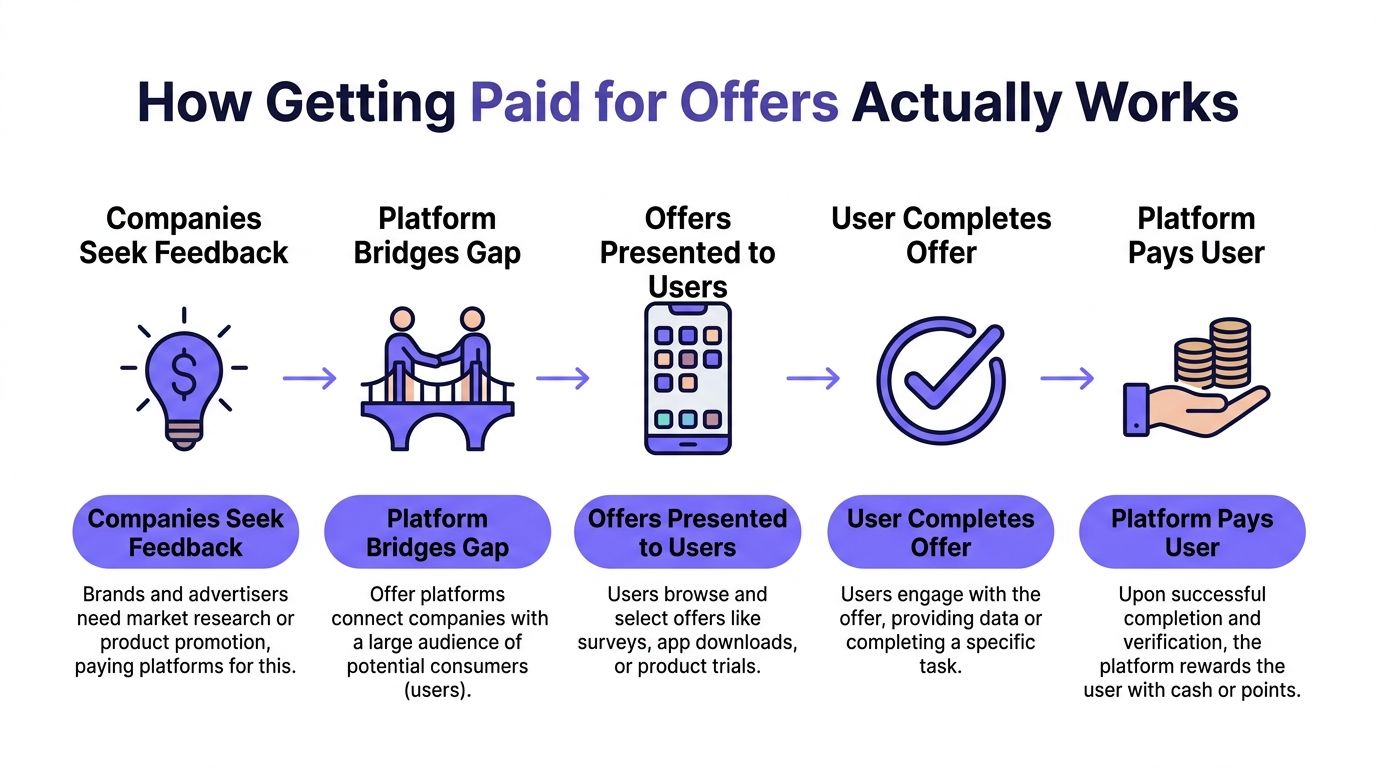
The simple business model
Think of an offer platform like a middleman that connects two groups:
Companies that want users
People willing to complete tasks for rewards
The company pays the platform when a user completes a required action. The platform then shares part of that payment with the user.
That payment model is often called performance-based advertising or cost per action. The key idea is simple. A company is not paying just because someone saw an ad. It pays because someone did something measurable.
Why a company would pay you at all
This is the question that helps you spot legit opportunities.
A real company pays for offers because the math can work in its favor. According to Klink Finance’s explanation of paid task economics, brands may pay $20 to $50+ per qualified user action like reaching a level in a game, because this model can produce 30 to 50% lower customer acquisition costs than traditional ads, and those users can bring 2 to 3x higher lifetime value.
That makes the model easier to believe.
If a company spends money on ads that people ignore, it wastes budget. If it pays only when a person installs, signs up, or stays engaged long enough to matter, the company gets a more useful result.
What an offerwall is
You will often see the word offerwall.
An offerwall is just a page or section inside an app or platform where different paid offers are listed. Each offer has rules, a reward amount, and completion steps.
You might also see terms like:
Partner offers: Tasks provided by outside advertisers or networks
Milestones: Specific targets, like reaching a game level
Tracking: The system that confirms you completed the action correctly
Pending rewards: Earnings that are waiting for confirmation
None of that is mysterious once you know the flow.
The flow from brand to user
Here is the basic chain:
A brand sets a goal: It wants installs, signups, gameplay, or survey responses.
The platform lists the task: Users see the offer and choose whether it is worth their time.
You complete the requirements: That might mean downloading an app, registering, or finishing a milestone.
The action gets verified: The platform checks whether you followed the rules.
You get paid: If everything tracks correctly, the reward is credited.
This is why instructions matter so much. If an offer says “new users only” and you already installed that app in the past, the advertiser may not count your action. If it says to finish on the same device, switching halfway can break tracking.
Why this model is more transparent than it first looks
At first glance, paid offers can seem random. Once you understand the money flow, they become easier to evaluate.
A real offer usually has a business reason behind it: A gaming company wants committed players, a survey buyer wants opinions from certain demographics, a finance app wants verified signups, a retail or service brand wants people to try its funnel.
That is also why paid offers are closely tied to digital advertising. If you want a clearer picture of how these promotions fit into mobile marketing, this piece on in-app advertisement adds useful context.
Practical rule: If you can clearly answer “who is paying, for what action, and why that action matters,” the offer is easier to trust. If you cannot, slow down.
Common Types of Paid Offers You Will Find
Open a typical rewards app and you will usually see a mix of jobs that look unrelated. One offer asks for a survey. Another pays for reaching level 20 in a game. A third wants you to install a finance app and verify your account.
They look different on the surface, but the business reason is usually easy to spot once you know what to look for. Some companies want feedback. Some want new users. Some want proof that a person will stick with a product long enough to become valuable.
The main offer categories
Surveys pay for your opinions and profile data. Market research firms buy responses because brands want feedback before launching products, changing prices, or testing ads. The catch is targeting. If a study needs parents in a certain age range or drivers in a specific region, many people will get screened out before they qualify.
Game offers pay for progress, not just a download. The advertiser is often a mobile game studio that can afford to pay for users who keep playing, make in-app purchases, or watch ads over time. That is why these offers often use milestones like reaching a level, completing chapters, or logging in for several days.
App trials usually focus on first-time use. A company may want installs, account creations, or one key action inside the app because that is the point where a casual visitor starts becoming a real user. If you want more detail on how these work, this guide on getting paid to download apps breaks down that category more closely.
Signup offers often come from subscription services, shopping apps, finance tools, or other brands with a conversion funnel. In plain English, they are paying for a qualified lead. That is why these offers often ask for more than a download. You may need to confirm an email, finish a profile, verify your identity, or complete a first transaction.
Professional research offers are a different tier. These are less common, but they can pay much better because the buyer wants a specific kind of person, such as a software manager, small business owner, nurse, or frequent traveler. User Interviews lists many research sessions that pay far more than standard microtasks, often for interviews, product tests, or diary studies on its participant opportunities page.
Passive data-sharing offers pay for permission to collect certain usage data over time. The company buying that data may want market trends, app usage patterns, or consumer behavior signals. The work is light after setup, but you should read the privacy terms carefully. Earnings tend to be modest, and a significant tradeoff is your data, not your time. A practical example appears in this summary of data-sharing apps reviewed by Side Hustle Nation.
Comparing Different Types of Online Offers
Offer Type | Typical Task | Effort & Time | Earning Potential | Best For |
|---|---|---|---|---|
Surveys | Answer questions and qualify for a study | Low to medium effort. Short tasks, but screening can add time | Usually small payouts per task. Better for short sessions than high hourly earnings | Beginners who want simple tasks |
Mobile games | Reach a level or finish milestone-based goals | Medium effort. Often needs repeat play over several days | Can beat surveys when milestone rewards stack and you finish the offer cleanly | People who already enjoy mobile gaming |
App trials | Install an app and complete first-use steps | Low to medium effort. Often quick if the instructions are clear | Usually ranges from small rewards to moderate payouts | Users who want faster completions |
Signup offers | Register, verify details, or complete a guided funnel | Medium effort. Accuracy matters more than speed | Often higher than basic installs because the advertiser wants a more valuable action | Detail-oriented users |
Professional research offers | Join niche studies or interviews | Higher effort and stricter eligibility | User Interviews regularly lists sessions with noticeably higher payouts than basic offer walls | Users with specific backgrounds or expertise |
Passive data-sharing offers | Allow approved apps to collect background usage data | Very low effort after setup | Usually slow, steady earnings rather than large one-time rewards | People who prefer low-maintenance earning |
Which type makes the most sense for you
The best category depends on how you already use your time.
If you have ten spare minutes here and there, surveys and app trials fit better because they are easier to start and finish in one sitting. If you already play mobile games at night, milestone offers can feel more natural because you are layering rewards onto a habit you already have. If you have specialized work experience, research panels may be worth checking before you spend hours on lower-paying tasks.
A simple way to choose is to match the offer to the kind of value the advertiser wants. Quick opinion needed. Survey. Retained user needed. Game or app milestone. Qualified lead needed. Signup flow.
That lens helps you avoid a common beginner mistake. People often chase the biggest number on the screen without noticing how much time, attention, or personal information the offer requires.
A beginner-friendly way to choose
Use this filter before starting:
Read the full requirement path: If you cannot explain the steps back to yourself in one sentence, skip it.
Match the task to your real attention span: A long game offer is a poor fit for a five-minute break.
Compare payout to friction: More forms, more verification, or more days of use should usually mean better pay.
Prefer clean completions over ambitious ones: Finished offers teach you more than half-finished experiments.
Tip: Early on, treat offer types like lanes on a highway. Pick one or two lanes that fit your pace, learn how tracking works there, and ignore the rest until you know what pays off for you.
Spotting the Scams and Finding Legitimate Platforms
This is the part that matters most.
A real paid offer can help you earn extra money. A fake one can waste your time, steal your information, or push you into sending money you never get back.

The danger is not theoretical. The FTC reported that losses from gamified job scams rose to over $220 million in the first half of 2024, and scammers often build trust with small early payouts before demanding larger deposits, frequently in cryptocurrency, according to the FTC’s data spotlight on gamified job scams.
That one pattern is worth memorizing. Small reward first. Deposit request later. That is a major red flag.
Red flags that should make you leave immediately
A bad platform usually reveals itself if you look closely.
They ask you to pay first: Real offer platforms pay you for completing tasks. They do not ask for a deposit to unlock better jobs.
They promise huge income for almost no work: Honest platforms describe tasks and rewards. Scams sell fantasy.
They pressure you to act fast: Urgency is often used to stop you from thinking.
They want sensitive information too early: Be cautious if a platform asks for details unrelated to account setup or payment.
They hide the offer rules: If you cannot tell what counts as completion, the setup is not trustworthy.
They push private chat groups full of success screenshots: Fake social proof is common in task scams.
Green flags that point to a legitimate setup
A solid platform is usually more boring than a scam. That is a good sign.
Look for these:
Clear offer instructions
Visible terms and payout methods
A support channel you can find
Reasonable reward structures
Transparent tracking or status updates
No demand to send money in order to earn money
One practical example is Klink Finance, which is a rewards platform where users complete tasks, surveys, game offers, and partner promotions, with real-time tracking of actions and earnings so users can see whether an offer is progressing before payout.
Questions to ask before you click
Use a short checklist.
Who is paying, and for what
If the reason behind the payment is impossible to explain, do not continue. A legitimate offer usually connects to a brand’s need for installs, signups, feedback, or engagement.
What happens if tracking fails
Good platforms usually explain the process, show progress, or give you a way to contact support. Scam setups tend to stay vague.
A quick explainer can help you see common tactics in action:
Are you being asked to recruit before you earn
Referral systems can be normal. A platform that makes recruitment the whole point is different. If the main task is bringing in more people instead of completing real advertiser actions, be careful.
Safety rule: If money starts flowing in the wrong direction, from you to them, stop. Legit paid offers online should reward your effort, not require your deposit.
Your First Steps to Start Earning Today
Starting well matters more than starting fast.
A lot of beginners lose their first rewards because they rush through setup, skip instructions, or pick offers that do not fit their time and profile. A calmer approach usually works better.
Step 1 Choose one platform and learn its rules
Do not open five platforms on day one.
Pick one, create your account, and read how that platform tracks offers. Pay attention to terms like “new users only,” device requirements, time limits, and pending periods. Those details decide whether you get paid.
Step 2 Set up your account carefully
Use accurate information. Earning opportunities are not distributed evenly. Task availability can vary based on location, age, and other demographics, and some research platforms use waitlists to keep participant pools balanced, as noted in this overview of online earning platform differences.
That means your profile affects what you see. It also means honesty is practical. False details can lead to mismatched offers or payment problems later.
Step 3 Start with an easy first offer
Your first goal is not maximum payout. Your first goal is a clean completion.
Good starter offers often include: simple app installs (fewer steps means fewer tracking mistakes); short surveys (good for learning how qualification works); low-friction engagement tasks (useful for seeing how rewards move from pending to paid).
Avoid your most ambitious choice at the start. A long game offer may be worth it later, but not before you understand the platform’s tracking style.
Step 4 Follow the instructions exactly
This sounds obvious, but it is where beginners slip.
If the offer says use the same device, use the same device. If it says first-time users only, do not assume “I installed it years ago but never used it” is close enough. If it requires a milestone, make sure you know what counts.
Common rookie mistakes
Clicking away before the offer loads fully
Using a different email from the one tied to the task
Skipping a required verification step
Forgetting screenshots when support might need proof
Starting multiple offers at once and mixing up the steps
Step 5 Track what you do
A simple note on your phone is enough.
Write down the offer name, when you started, what the completion rule was, and whether the reward showed as pending. This saves you from second-guessing later.
Tip: Treat your first week like a test run. You are not just earning. You are learning which offers fit your habits, your region, and your patience level.
Step 6 Build a routine instead of chasing every task
Consistency beats randomness.
A better pattern is to check for new offers at regular times, choose tasks you can realistically finish, and avoid filling your day with half-completed attempts. Some people like short tasks during breaks and one longer offer in the evening. Others prefer only quick wins. Both can work.
Step 7 Move toward higher-value opportunities carefully
Once you know the basics, you can become more selective.
Look for offers with clear milestones, realistic instructions, and payout structures that match your effort. If a task feels confusing before you start, it feels worse halfway through.
The point is not to do the most offers. The point is to complete the right offers cleanly.
Cashing Out Your Earnings and Other Practical Tips
Earning is only half the job. Getting the money out matters just as much.
A platform can look good on the surface and still frustrate users at payout time. That is why beginners should pay attention not just to rewards, but also to withdrawal rules, minimum thresholds, and verification delays.
Why payout speed matters more than people expect
A reward does not feel very useful if it sits locked in your account.
According to Indeed’s overview of survey-for-money platforms, many services advertise quick payouts, but hidden checks can delay a first withdrawal by 7 to 14 days. Platforms with instant cash-outs create a smoother experience because waiting on verification can lower the practical value of your time.
That matters most when you are using paid offers for small, flexible income. Slow access turns a simple side hustle into a waiting game.
What to look for before you cash out
Different platforms use different payout methods. The common ones include cash transfers, gift cards, and bank-linked withdrawals.
Before you invest time, check these points:
Minimum withdrawal amount: A low minimum lets you test the platform without waiting forever
Verification process: Know whether identity checks happen at signup or at withdrawal
Payment options: Choose platforms that support methods you will use
Processing clarity: The platform should explain whether rewards are instant, pending, or manually reviewed
For readers who care most about payment speed, this guide to apps that pay you instantly is worth a look.
A practical way to think about cash-out rules
Fast cash-out is not just a convenience feature. It changes your real experience.
If one platform pays quickly with a low minimum and another keeps your first withdrawal stuck behind extra checks, the same reward amount can feel very different. That is one reason some users prefer platforms with instant withdrawals in supported currencies. Klink Finance, for example, supports fast cash-outs in multiple currencies, which is useful for users who do not want earnings tied up in long waits.
Keep your own records
Even if your side-hustle income is modest, tracking it is smart.
Keep a simple log of:
What you earned
When you withdrew
Which platform paid you
Any fees or delays you noticed
That habit helps with budgeting, and it makes tax reporting easier if your earnings grow over time.
Practical takeaway: Do not judge a platform only by the headline reward. Judge it by how clearly and how quickly it lets you access what you earned.
Frequently Asked Questions About Paid Online Offers
Are paid offers the same as online jobs
Paid offers sit closer to task-based gigs than traditional online employment.
You are usually completing a defined action, such as installing an app, finishing a survey, reaching a game milestone, or signing up for a trial. The platform pays because an advertiser funded that action. That business model matters, because it explains why the work is available in bursts instead of arriving like a steady shift schedule.
How much can a beginner realistically earn
A beginner should treat paid offers like extra cash, not rent money.
Your results depend on two things. First, which offers are available to your profile. Second, how selective you are about time versus reward. A short survey that pays a little can make sense. A game offer that takes days only makes sense if the payout justifies the effort.
Do I need special skills
Most offers do not require technical skills or formal experience.
The useful skills are practical ones. Read instructions carefully, notice small requirements, and keep simple records so you can follow up if something fails to track. Those habits save more money than any special talent.
Why do some people earn more than others
Paid offers work a lot like coupons mailed to different households. The deal changes based on who the advertiser wants to reach.
That is why two people can open the same platform and see very different options. Your location, device, age range, and interests can affect which campaigns you receive and which ones pay more.
Are surveys better than game offers
The better choice depends on what kind of tradeoff you prefer.
Surveys are usually easier to start and easier to finish in one sitting. Game offers often ask for more time, but they can pay more if you enjoy playing and can hit the required milestones without spending money inside the app. If you are unsure, test both for a few days and compare your real hourly return.
What should I do if an offer does not track
Check the rules first. Many tracking problems come from a missed step, such as using the wrong device, skipping permissions, or installing an app before clicking through the offer wall.
If you followed the instructions, collect proof right away. Screenshots, timestamps, confirmation emails, and your user ID make support requests much easier. This is one of the clearest differences between organized users and frustrated users.
Is it safe to share personal information
Share only the information that matches a real business purpose, such as account setup, identity verification, or payment processing.
A legitimate platform should explain what it needs and why. If a site asks for highly sensitive details that do not match the offer, pushes you to pay upfront, or stays vague about who runs the platform, treat that as a warning sign and leave.
If you want to try a platform built around this model, Klink Finance lets users earn by completing tasks, surveys, app offers, and game-based promotions, with real-time tracking and flexible cash-out options. It is one example of how paid offers work when the business model is clear and the earning process is visible.

High Quality Offers,
Real Payouts
Start Earning with Klink Now!







Share Article
Related Articles
Read more, Earn more